Infrared Lenses
We work on a wide range of infrared materials that covers almost full infrared spectrum. Hyperion Optics supplies Zinc Selenide, Zinc Sulfide, Silicon, Germanium, Gallium Arsenide, and Calcium Fluoride, Barium Fluoride as well as Chalcogenide spherical lenses and aspherical lenses. We use laser based edging device to control MWIR and LWIR lenses’ decenter deviation, and test on reflective centering station to fulfill extreme precise tasks.
Zinc Selenide has great transmittance through the band 0.5-22μm, especially at 10.6μm, and is commonly used in thermal imaging and FLIR systems, also its outstanding low absorption coefficient and high resistance to thermal shock makes it an ideal choice for high power CO2 laser applications. For laser ZnSe components please browse our Laser Optics category for more information.
Since Zinc Selenide is a relatively soft material that scratches and digs can be easily remained on the surfaces during processing flow, it is not recommended for use within harsh environments, Hyperion Optics’ advanced manufacturing techniques for ZnSe ensure superior surface quality compared to our competitors. For cosmetic sensitive systems, our best effort can reach 20-10 in S/D grade. ZnSe aspheric lenses are also available for your application; please refer to IR Aspheric Lenses for more information. ZnSe Dome optics are also available in our Dome category.

Our infrared lenses are also available with AR coating according to specific requirement. Please take great care when handling, mounting and cleaning infrared lenses, further, For your safety, please follow all proper precautions, including wearing gloves when handling these lenses and thoroughly washing your hands afterward.
In addition, along with our outstanding aspherical (including DOE surface) manufacturing capability, Hyperion Optics is definitely one of your best choices in SWIR/MWIR/LWIR lenses development project.
Types of infrared lenses:
Chalcogenide Lenses
Barium Fluoride Lenses
Calcium Fluoride Lenses
Magnesium Fluoride Lenses
Gallium Arsenide Lenses
Germanium Lenses
Sapphire Lenses
Silicon Lenses
Zinc Selenide Lenses
Zinc Sulfide Lenses
Take two as examples:
Chalcogenide Lenses
Chalcogenide glass is containing one or more chalcogens (sulfur, selenium and tellurium, but excluding oxygen). Chalcogenide components are becoming popular in various IR applications due to its excellent wide band transmittance (3-5µm, 8-12µm) with reliable machinability, which perform rather differently from oxides; particularly low band gaps help optical designers to introduce more flexible IR solutions.
Zinc Sulfide Lenses
Based on Hyperion Optics' IR material processing capability, we now introduce our Chalcogenide glass family components, as equipped with the most advanced manufacturing devices, Hyperion Optics is able to deliver quality Chalcogenide components just like other IR materials. Our Chalcogenide material inventory ranges from Schott IRG22, IRG23, IRG24, IRG25, IRG26; in addition, as our partnership with China based material vendor HUBEI NEW HUAGUANG (Known as NHG) Material Technology Co., Ltd,. We also supply Chalcogenide components with their Chinese equivalents which is a highly cost-effective solution for our potential customer whether it is a concept approval project or series production scenario.
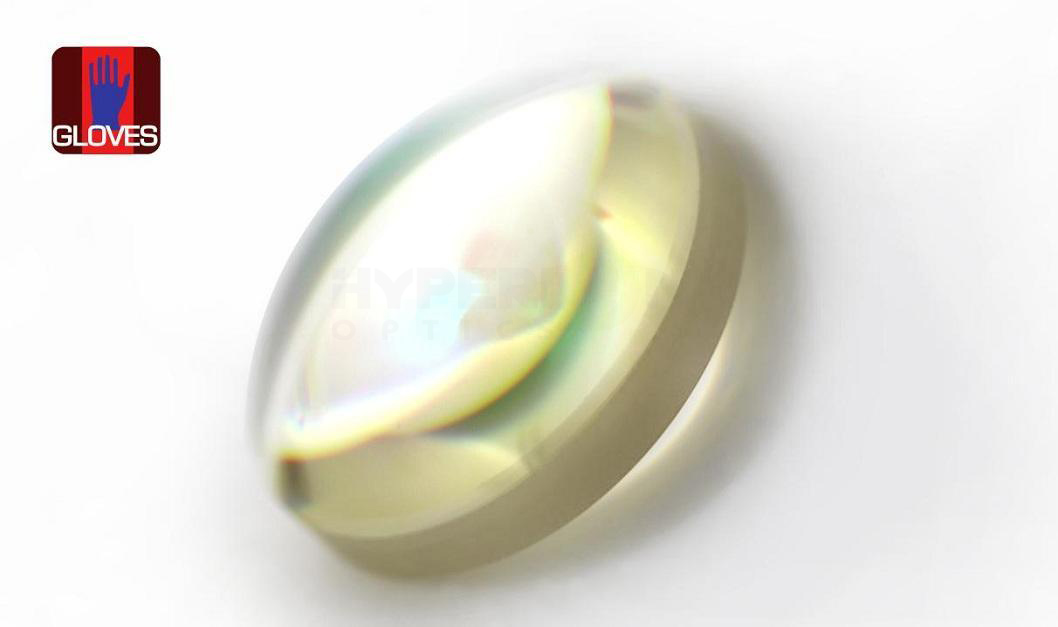
With the rapid development of military weaponry and correlative targeting and monitoring systems, ZnS is widely utilized in multi-spectral IR applications. Its relatively high transmittance through 3-5µm and 8-10µm enable ZnS being an ideal choice for multi-spectral applications. Further, within NIR and SWIR range, CLEARTRAN CVD ZnS can also be considered as indispensable alternative for optical designers.
Labels: Chalcogenide Lenses, Infrared Lenses, lens, lens optical design, optical lens, optics china, Spherical Lenses, Zinc Sulfide Lenses, ZnSe aspheric lenses
posted by hypoptics @ September 06, 2017
0 Comments


