Wednesday, November 8, 2017

Fisheye Lenses for sale

Fisheye Lenses

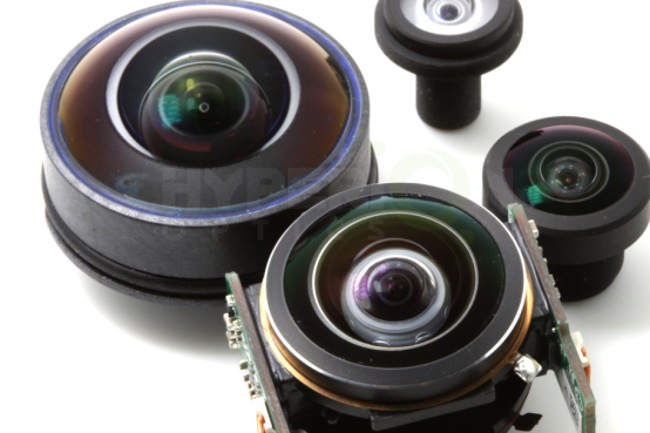
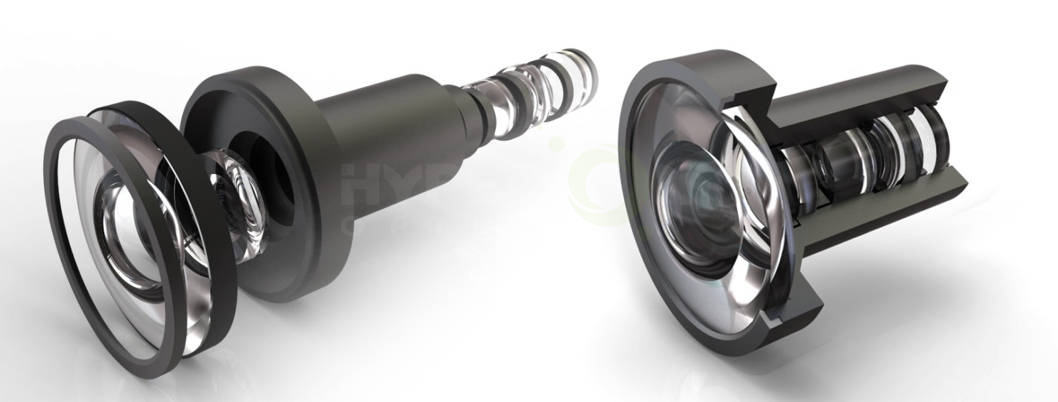
Typically fisheye lens has a front lens group of a greater negative refractive power than an ordinary inverted telephoto wide angle lens, with a large back focal distance. Its extreme power distribution will cause great field curvature in the transmitted image. As fisheye lens leads to significant barrel shaped distortion, to improve field curvature and astigmatism, it is necessary to compose a doublet to avoid significant negative deviation and provide correction of chromatic aberration.

Hyperion Optics designers’ expertise contributes various range of fisheye lenses customized projects, from sminiature fisheye lense used for 360 degree viewing device to 200mm in diameter dome projection fisheye lenses. Our fisheye lens database provides design result and simulations for full frame fisheye lenses, circular image (hemispherical) fisheye lenses with different focal length options.
Hyperion Optics design

Hyperion fishy lense

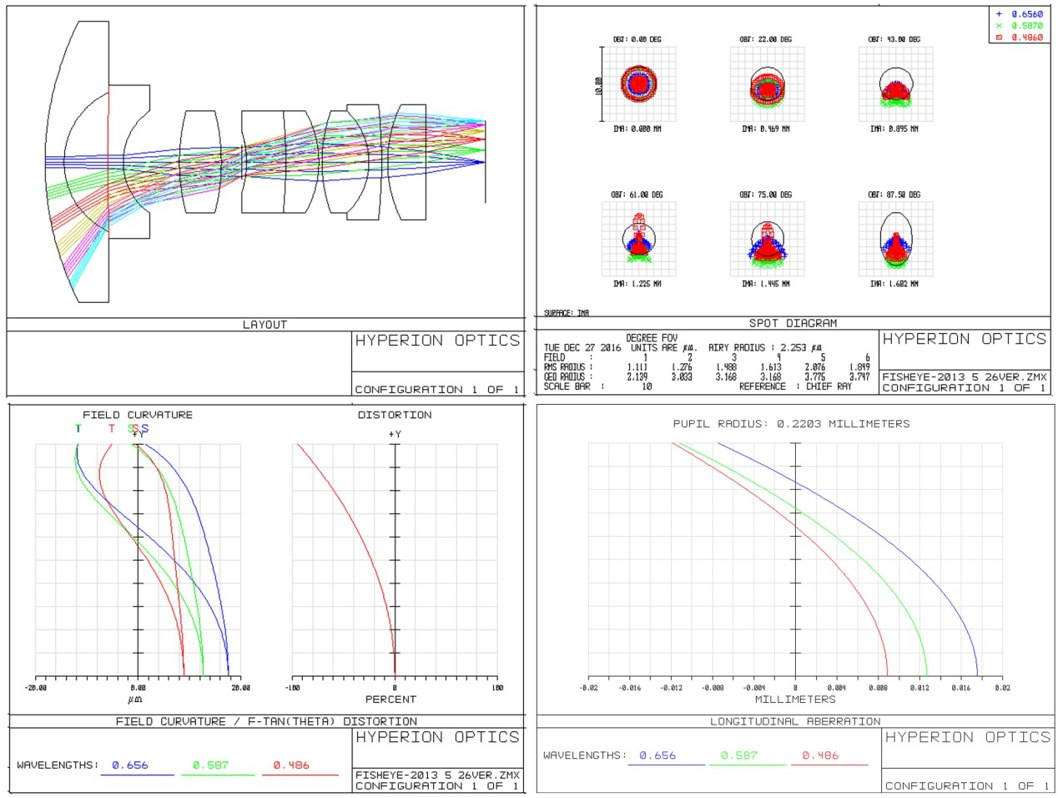
During design process, our designers evaluate relative illumination performance by utilizing real ray trace analysis, vignetting is also used to control off-axis aberrations due to a half stop or full stop in relative illumination is tolerable in conventional photography scenario. Distortion departure from f-theta mapping is also critical in our design phase, according to the initial simulation and calculation; our designers are able to adjust and optimize to reach an ideal solution. We also look into lateral color which is the lateral shift on the image plane intersection between the shortest wavelength chief ray and the longest wavelength chief ray by real ray trace analysis.

Labels: , , , , , , ,

Wednesday, September 6, 2017

Cylindrical Lenses for customizition

Hyperion Optics' cylindrical components have been widely used for laser based applications with reliable optical performance and durability. We are able to provide Zygo report of all cylindrical surfaces we produce, and intensive measurement can be met upon customer’s request, such as optical axis deviation.

We are working closely to innovators and photography equipment designers who develop customized anamorphic systems where use cylindrical lenses as image aspect ratio changer.

For attach-on anamorphic lenses for smart phones, anamorphic cinema projection system, and front mounted anamorphic attachment. Please check out our anamorphic lenses for more information. If you are in the stage of developing your own anamorphic lenses, don’t hesitate contacting one of our optical engineers for free consultation to receive assistant from manufacturing perspective.

At Hyperion optics, we keep utilizing optical edging technique for most demanding requirement, which is essential in cylindrical component manufacturing. We provide full inspection data along with shipment including Zygo interferometry report and centering testing results.

Achromatic cylindrical lenses are ideal for eliminating spherical and chromatic aberration at the image plane, for example using monochromatic light source, achromatic cylindrical lenses can form a 50-90% smaller spot compared to singlet.

For most severe laser or imaging applications which involve cylindrical components, such as anamorphic projection, anamorphic photography, and achromatic cylindrical lenses are introduced. Hyperion Optics can manufacture based on custom design doublet or triplet achromatic cylindrical cemented lenses by using centering alignment device with UV curing unit to process precision bonding and testing at the same time. Every singlet is fully inspected before bonding.

anamorphic lenses

Fresnel lenses

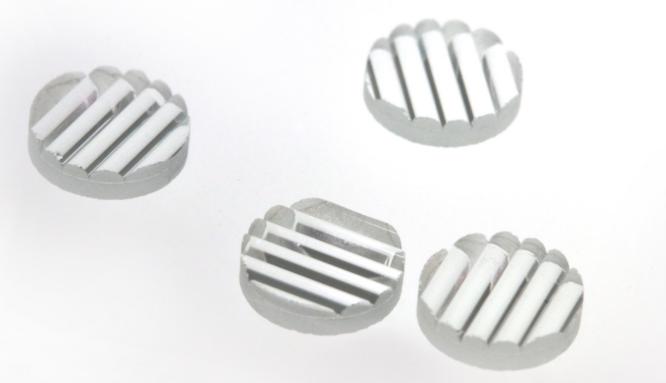
Hyperion Optics provides various fan angle line generating Fresnel lenses for laser alignment and machine vision applications. Unlike ordinary cylindrical lenses, line generating Fresnel lenses can produce uniform distribution of energy along the line.

We provide in both optical glass (N-BK7 or equivalent) and plastic version for your specific requirement. With our highly efficient cementing techniques, we support low volume customized solution and performance trial. Please note, free sampling is available upon request for all fan angle products.

Diameter varies from 4mm to 8mm, 2/2.5mm +/-0.1mm in center thickness. Fan angle available from 110°, 20°, 14°, 10°, or custom made. Our optical glass version line generating Fresnel lenses have much better imaging quality, which is also high working temperature durable. Compared to rod lenses, our products are much easier to mount.

Cylindrical lenses

Cylindrical lenses are used to focus, expand or condense light into a single dimension. Cylindrical lenses are widely used in laser scanners, optical information processing and computing, dye lasers or anamorphic lenses. Hyperion Optics has decade of cylindrical lenses manufacturing experience, ranging from ordinary plano-convex, plano-concave to cemented achromatic cylindrical lenses.

For most laser applications, Hyperion Optics’ cylindrical lenses offer always comes with competency in price; our monthly capability is 3,000 pcs. For prototyping quantity, we provide interferometry report along with the shipment upon request.

Rod and Cone Lenses
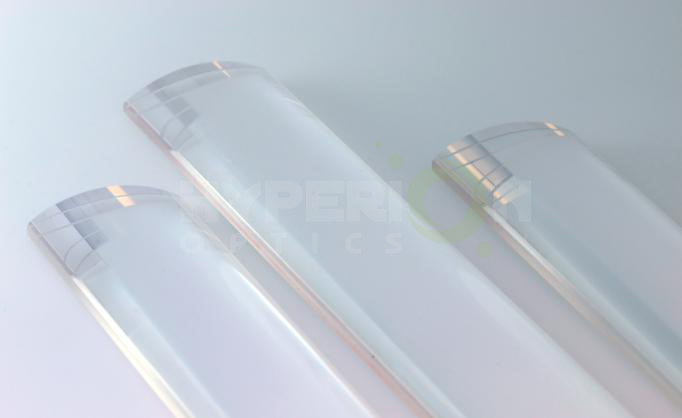
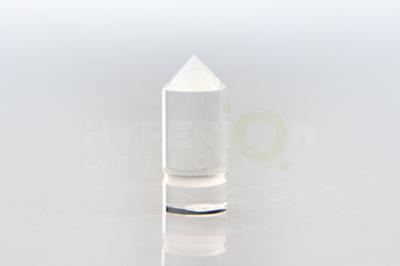
Rod lenses’ optical performance is similar to cylindrical lenses, incident collimated light passes through the polished circumference of the rod lens will be formed into a line. Variety of laser and imaging applications utilize rod lenses as line generator optics.

Hyperion Optics provides a range from micro sized rod lenses manufactured with variety of optical materials including fused silica ultra-violet version for OEM applications, also custom sizes and variations in surfaces requirement additional coatings are available upon request.

Engineers normally find that the optical uniformity varies from center to the two ends on a rod lens, Hyperion Optics insists polishing circumference on a longer length rod substrates then slice and ground the ends to tolerance to yield a better polishing result which would impact on the overall line uniformity in actual use.

Labels: , , , , ,

Infrared Lenses

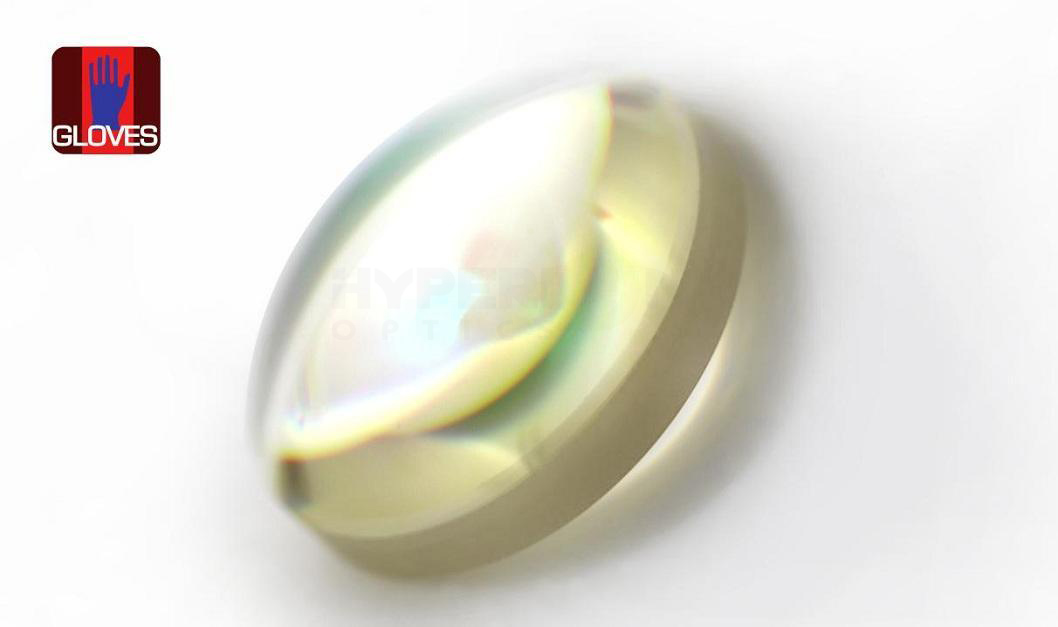
We work on a wide range of infrared materials that covers almost full infrared spectrum. Hyperion Optics supplies Zinc Selenide, Zinc Sulfide, Silicon, Germanium, Gallium Arsenide, and Calcium Fluoride, Barium Fluoride as well as Chalcogenide spherical lenses and aspherical lenses. We use laser based edging device to control MWIR and LWIR lenses’ decenter deviation, and test on reflective centering station to fulfill extreme precise tasks.

Zinc Selenide has great transmittance through the band 0.5-22μm, especially at 10.6μm, and is commonly used in thermal imaging and FLIR systems, also its outstanding low absorption coefficient and high resistance to thermal shock makes it an ideal choice for high power CO2 laser applications. For laser ZnSe components please browse our Laser Optics category for more information.

Since Zinc Selenide is a relatively soft material that scratches and digs can be easily remained on the surfaces during processing flow, it is not recommended for use within harsh environments, Hyperion Optics’ advanced manufacturing techniques for ZnSe ensure superior surface quality compared to our competitors. For cosmetic sensitive systems, our best effort can reach 20-10 in S/D grade. ZnSe aspheric lenses are also available for your application; please refer to IR Aspheric Lenses for more information. ZnSe Dome optics are also available in our Dome category.


Our infrared lenses are also available with AR coating according to specific requirement. Please take great care when handling, mounting and cleaning infrared lenses, further, For your safety, please follow all proper precautions, including wearing gloves when handling these lenses and thoroughly washing your hands afterward.

In addition, along with our outstanding aspherical (including DOE surface) manufacturing capability, Hyperion Optics is definitely one of your best choices in SWIR/MWIR/LWIR lenses development project.

Types of infrared lenses:

Chalcogenide Lenses
Barium Fluoride Lenses
Calcium Fluoride Lenses
Magnesium Fluoride Lenses
Gallium Arsenide Lenses
Germanium Lenses
Sapphire Lenses
Silicon Lenses
Zinc Selenide Lenses
Zinc Sulfide Lenses

Take two as examples:

Chalcogenide Lenses

Chalcogenide glass is containing one or more chalcogens (sulfur, selenium and tellurium, but excluding oxygen). Chalcogenide components are becoming popular in various IR applications due to its excellent wide band transmittance (3-5µm, 8-12µm) with reliable machinability, which perform rather differently from oxides; particularly low band gaps help optical designers to introduce more flexible IR solutions.

Zinc Sulfide Lenses


Based on Hyperion Optics' IR material processing capability, we now introduce our Chalcogenide glass family components, as equipped with the most advanced manufacturing devices, Hyperion Optics is able to deliver quality Chalcogenide components just like other IR materials. Our Chalcogenide material inventory ranges from Schott IRG22, IRG23, IRG24, IRG25, IRG26; in addition, as our partnership with China based material vendor HUBEI NEW HUAGUANG (Known as NHG) Material Technology Co., Ltd,. We also supply Chalcogenide components with their Chinese equivalents which is a highly cost-effective solution for our potential customer whether it is a concept approval project or series production scenario.

With the rapid development of military weaponry and correlative targeting and monitoring systems, ZnS is widely utilized in multi-spectral IR applications. Its relatively high transmittance through 3-5µm and 8-10µm enable ZnS being an ideal choice for multi-spectral applications. Further, within NIR and SWIR range, CLEARTRAN CVD ZnS can also be considered as indispensable alternative for optical designers.

Labels: , , , , , , , ,

Tuesday, May 9, 2017

Optical lens design for adaptation of traditional lights to LED

ABSTRACT

An Italian company operating in the field of renewable energy has developed a system to customize traditional lights adapting them with LED lighting. The company is looking for research institutes that can develop further applications (i.e. optical lens design for LED lighting) under technical cooperation agreement.

FULL DESCRIPTION

The company's activity concerns the customization of traditional lights adapting them with LED lights technology. 

LED lights technology can offer the advantage to have high reduction of energy consuming compared with traditional lights or energy saving lights. Another advantage of the LED technology is its long life. LED bulbs have an outstanding operational life time expectation of up to 50.000 hours. This is around 17 years considering 8 working hour per day before one would have to replace the LED bulb.
LED lights are also eco-friendly because they are free of toxic chemicals. Most conventional fluorescent lighting bulbs contain a multitude of materials like e.g mercury that are dangerous for the environment. LED lights contain no toxic materials and are 100% recyclable. The long operational life time span mentioned above also means that one LED light bulb can save material and production of 25 incandescent light bulbs.
Also, LED lights can switched off and on frequently and without affecting the LED’s lifetime or light emission. In contrast, traditional lighting may take several seconds to reach full brightness, and frequent on/off switching does drastically reduce operational life expectancy.
During the design stage the company considers the wattage and the luminous flux of the original lamps, the type of LED to install can this be chosen.

The aim of the company is to offer specific products for customers' needs; thus, they are seeking collaborations with institutes under technical cooperation agreement. The ideal partner would be able to develop specific applications like for example optical lens for LED lighting. A lens is an optical device which transmits and refracts light, converging or diverging the beam. A simple lens consists of a single optical element. A compound lens is an array of simple lenses (elements) with a common axis; the use of multiple elements allows more optical aberrations for correction than what would be possible with a single element. Lenses are typically made of glass or transparent plastic.
Commercial LEDs are usually provided with an optical lens with beam angle of 120°. This characteristic could be a limit of the LED lighting. Depending on the ambiance to illuminate, a customer could need a spot light or a light with an wider angle. According to the company's policy of customers support in their specific needs, the company is seeking for University and R&D institutions to collaborate with to develop optical lens with different beam angle.

Partner expertise sought:

- Type of partner sought: Others important aspects to consider are the Colour Temperature (CCT), according to the ambiance where the lamp will be installed, and the Colour Rendering Index (CRI)
One more important aspect to consider is the heat sink, whose design is basic for the life span of the LED. 
- Specific area of activity of the partner: The company is looking for research institutes that can develop further applications and adaptation of traditional lights to LED lights technology (i.e. optical lens for LED lights, OLED applications) under technical cooperation agreement. 

Labels: , , ,