Wednesday, November 8, 2017

Fisheye Lenses for sale

Fisheye Lenses

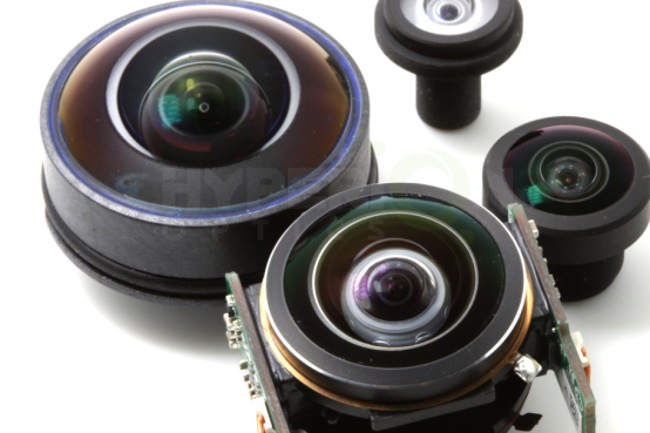
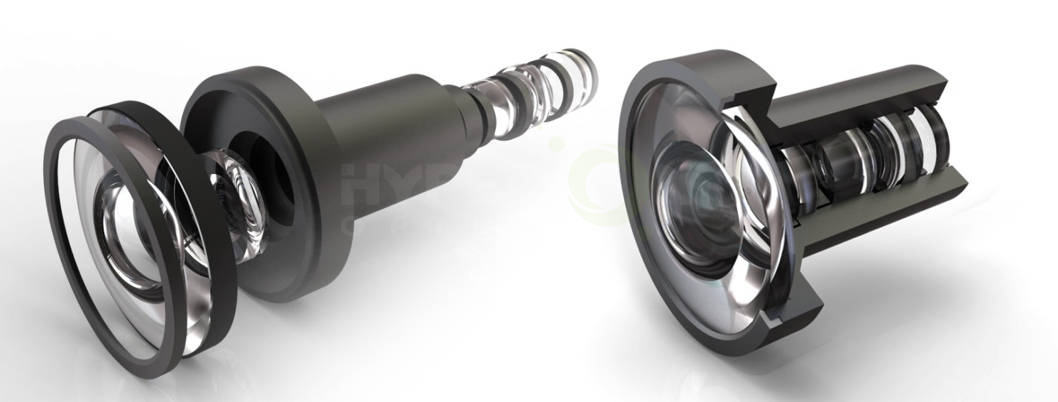
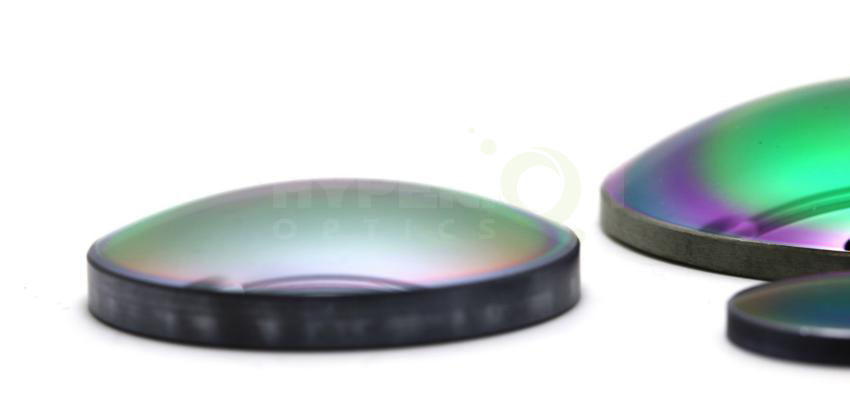
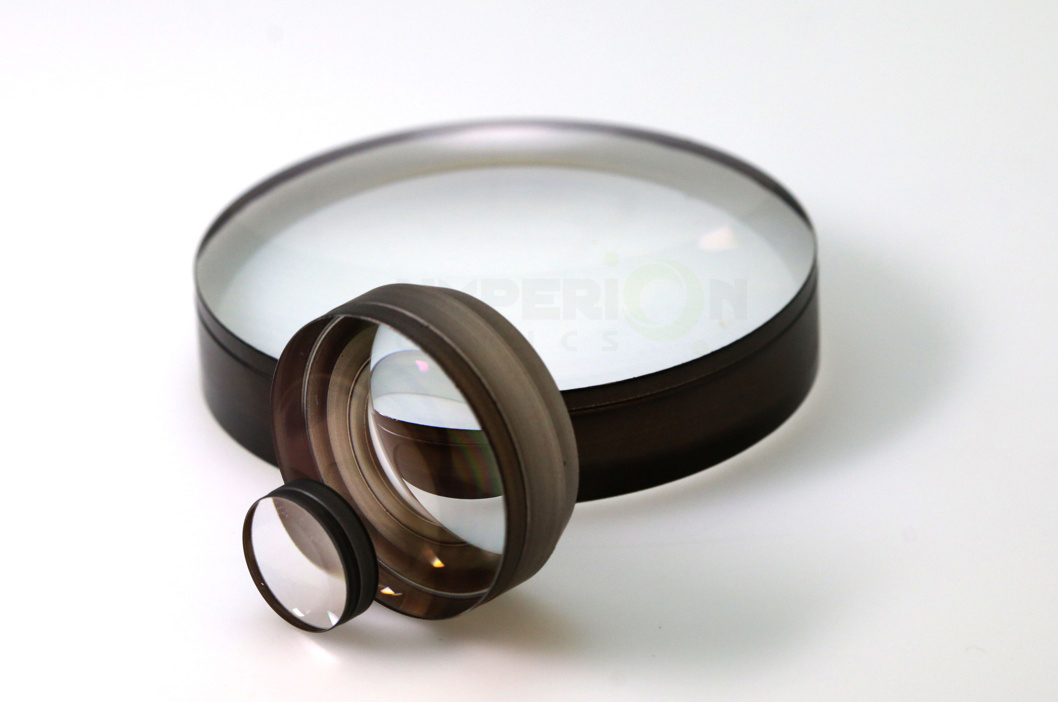
Typically fisheye lens has a front lens group of a greater negative refractive power than an ordinary inverted telephoto wide angle lens, with a large back focal distance. Its extreme power distribution will cause great field curvature in the transmitted image. As fisheye lens leads to significant barrel shaped distortion, to improve field curvature and astigmatism, it is necessary to compose a doublet to avoid significant negative deviation and provide correction of chromatic aberration.

Hyperion Optics designers’ expertise contributes various range of fisheye lenses customized projects, from sminiature fisheye lense used for 360 degree viewing device to 200mm in diameter dome projection fisheye lenses. Our fisheye lens database provides design result and simulations for full frame fisheye lenses, circular image (hemispherical) fisheye lenses with different focal length options.
Hyperion Optics design

Hyperion fishy lense

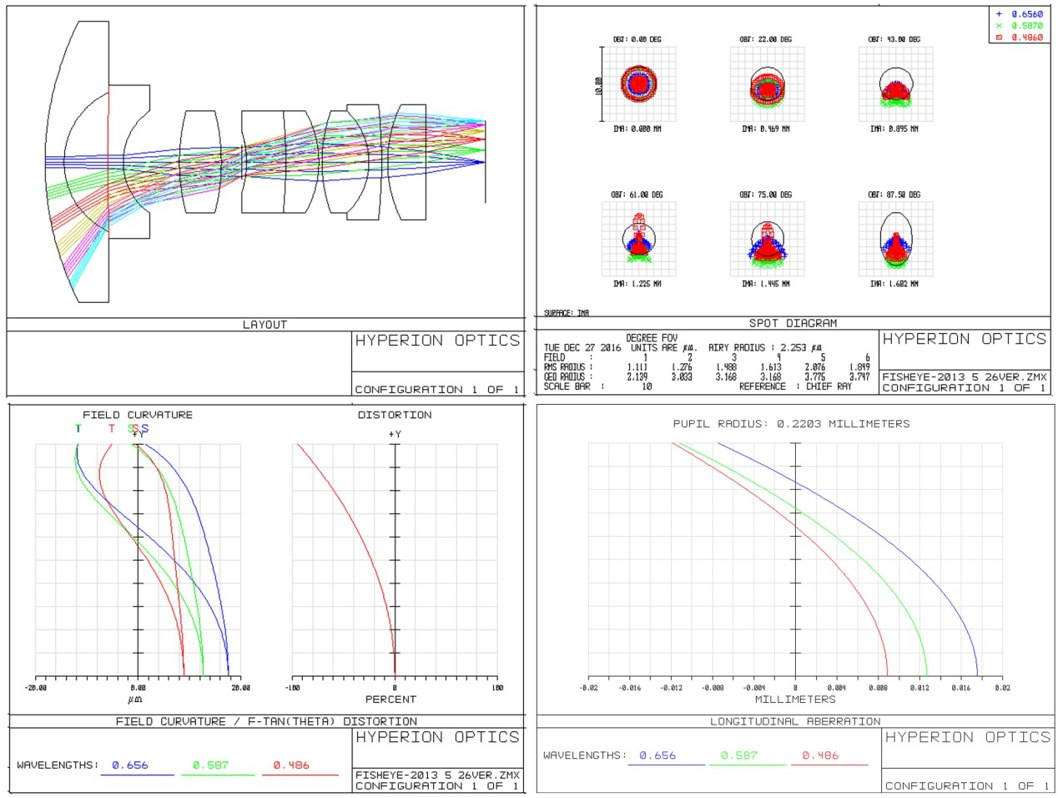
During design process, our designers evaluate relative illumination performance by utilizing real ray trace analysis, vignetting is also used to control off-axis aberrations due to a half stop or full stop in relative illumination is tolerable in conventional photography scenario. Distortion departure from f-theta mapping is also critical in our design phase, according to the initial simulation and calculation; our designers are able to adjust and optimize to reach an ideal solution. We also look into lateral color which is the lateral shift on the image plane intersection between the shortest wavelength chief ray and the longest wavelength chief ray by real ray trace analysis.

Labels: , , , , , , ,

Wednesday, September 6, 2017

Aspherical Lenses

Hyperion Optics’ manufacturing equipment expand our aspherical products’ deliverability to LWIR applications, from high precision VIS imaging systems to infrared athermal lenses, we are able to process on optical glasses and infrared materials such as Germanium, Zinc Sulfide, Zinc Selenide, Calcium Fluoride, Chacolgenide glasses etc.

We insist to simulate every aspherical equation and specs from customer’s inquiry to make sure we are capable of delivery, and provide suggestions based on our study and understanding. For complicated design, we are willing to run trial test on H-K9 glass to verify your design’s feasibility, with profiler map provided for customer’s reference.

Our aspherical lenses manufacturing cost also assists our customers to use aspherical surfaces in their design to achieve better system performance or compactable goal, meanwhile keep pricing competency in the market.

We are able to work on optics LRIP project (low ratio initial production) , such as 5-10 pieces for optical feasibility study, to volume 200 pieces to 500 pieces production. Let us know your delivery plan; we can work on precise part dispatch planning.

Asphere Lenses

Optical Machining Centers

Due to the more complex surface profile of asphere which significantly reduces or eliminate optical aberrations as compared to the simple lens, Aspheric lenses have at least one surface that is not a true sphere,It has been more widely exploited in the lens optical design stage.

IR Asphere Lenses


aspheric parts in LIRP project
At Hyperion Optics, we work with various infrared materials. Besides spherical parts, with increasing demand of IR aspheric components, designers are more likely to use aspheric parts in LIRP projects to meet relatively reliable performance meanwhile to decrease the element quantity within the system. Our aspheric component manufacturing capability covers 0.8 micron up to 12 micron for your infrared application from combination of materials needed in order to achieve your application expectation.

Diffractive Optical Elements

Diffractive optical elements (DOEs)

Diffractive optical elements (DOEs) shape and split laser beams in an energy-efficient manner. You can implement a broad range of applications with minimal light loss – examples of diffractive micro optics can be found in production facilities for laser material processing, in medical laser treatments and diagnostic instruments, in areas such as lighting, printing technologies, and lithography as well as in measuring and metrology systems. DOEs are used to pattern light in work areas for custom illumination. Hyperion Optics offers DOEs for all wavelengths across the spectrum.

Parabolic Mirrors

Parabolic reflectors design

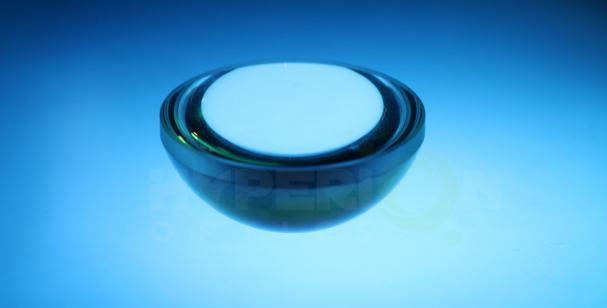
Parabolic reflectors are used to collect energy from a distant source (for example sound waves or incoming star light). Since the principles of reflection are reversible, parabolic reflectors can also be used to focus radiation from an isotropic source into a narrow beam. In optics, parabolic mirrors are used to gather light in reflecting telescopes and solar furnaces, and project a beam of light in flashlights, searchlights, stage spotlights, and car headlights. In radio, parabolic antennas are used to radiate a narrow beam of radio waves for point-to-point communications in satellite dishes and microwave relay stations, and to locate aircraft, ships, and vehicles in radar sets. In acoustics, parabolic microphones are used to record faraway sounds such as bird calls, in sports reporting, and to eavesdrop on private conversations in espionage and law enforcement.

Labels: , , , , , ,

Infrared Lenses

We work on a wide range of infrared materials that covers almost full infrared spectrum. Hyperion Optics supplies Zinc Selenide, Zinc Sulfide, Silicon, Germanium, Gallium Arsenide, and Calcium Fluoride, Barium Fluoride as well as Chalcogenide spherical lenses and aspherical lenses. We use laser based edging device to control MWIR and LWIR lenses’ decenter deviation, and test on reflective centering station to fulfill extreme precise tasks.

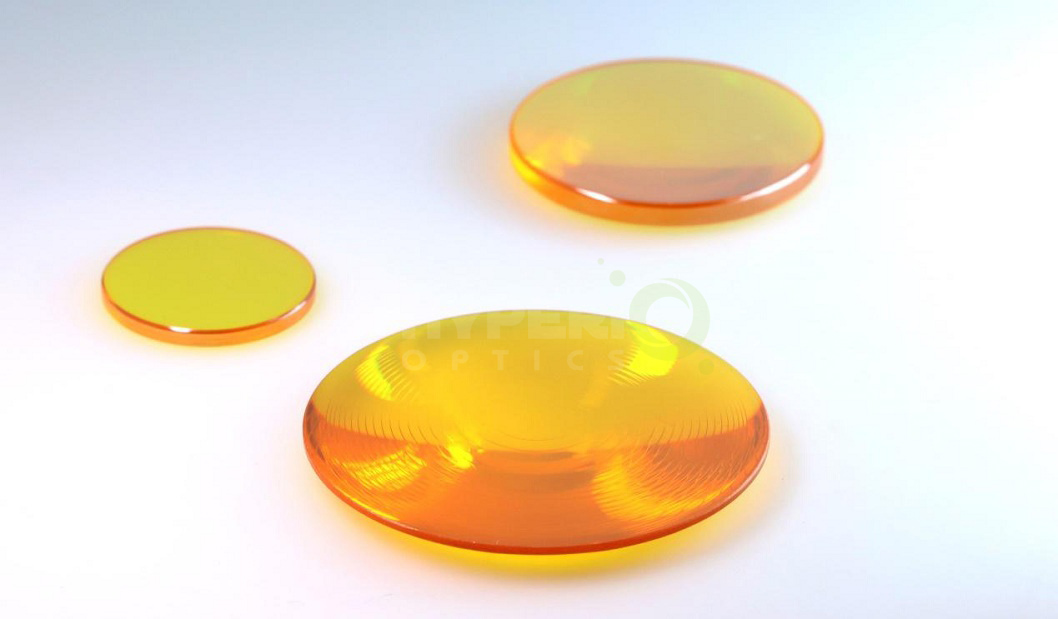
Zinc Selenide has great transmittance through the band 0.5-22μm, especially at 10.6μm, and is commonly used in thermal imaging and FLIR systems, also its outstanding low absorption coefficient and high resistance to thermal shock makes it an ideal choice for high power CO2 laser applications. For laser ZnSe components please browse our Laser Optics category for more information.

Since Zinc Selenide is a relatively soft material that scratches and digs can be easily remained on the surfaces during processing flow, it is not recommended for use within harsh environments, Hyperion Optics’ advanced manufacturing techniques for ZnSe ensure superior surface quality compared to our competitors. For cosmetic sensitive systems, our best effort can reach 20-10 in S/D grade. ZnSe aspheric lenses are also available for your application; please refer to IR Aspheric Lenses for more information. ZnSe Dome optics are also available in our Dome category.


Our infrared lenses are also available with AR coating according to specific requirement. Please take great care when handling, mounting and cleaning infrared lenses, further, For your safety, please follow all proper precautions, including wearing gloves when handling these lenses and thoroughly washing your hands afterward.

In addition, along with our outstanding aspherical (including DOE surface) manufacturing capability, Hyperion Optics is definitely one of your best choices in SWIR/MWIR/LWIR lenses development project.

Types of infrared lenses:

Chalcogenide Lenses
Barium Fluoride Lenses
Calcium Fluoride Lenses
Magnesium Fluoride Lenses
Gallium Arsenide Lenses
Germanium Lenses
Sapphire Lenses
Silicon Lenses
Zinc Selenide Lenses
Zinc Sulfide Lenses

Take two as examples:

Chalcogenide Lenses

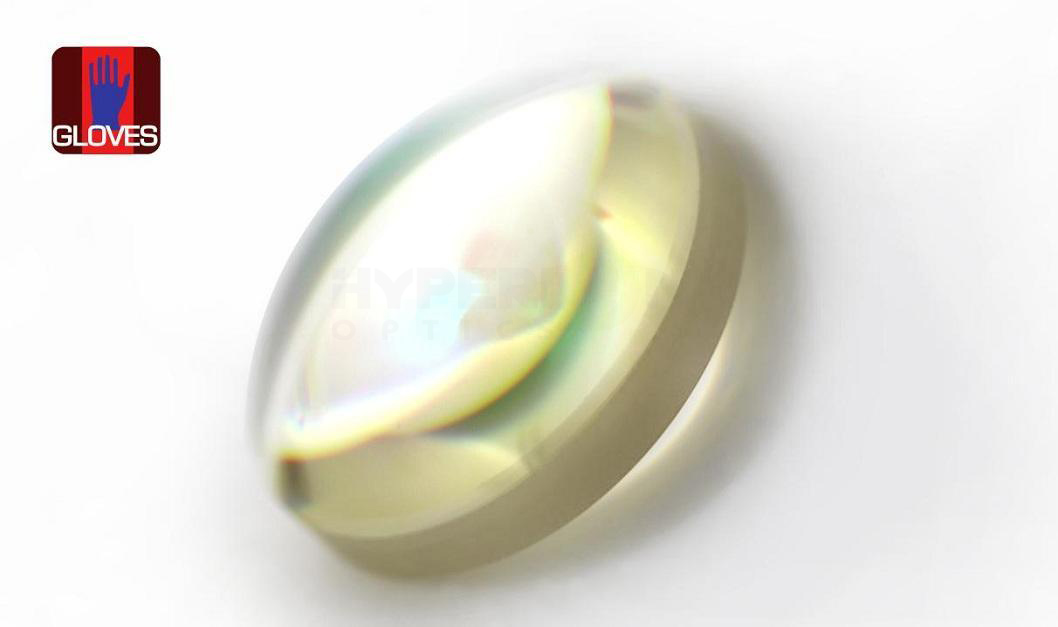
Chalcogenide glass is containing one or more chalcogens (sulfur, selenium and tellurium, but excluding oxygen). Chalcogenide components are becoming popular in various IR applications due to its excellent wide band transmittance (3-5µm, 8-12µm) with reliable machinability, which perform rather differently from oxides; particularly low band gaps help optical designers to introduce more flexible IR solutions.

Zinc Sulfide Lenses


Based on Hyperion Optics' IR material processing capability, we now introduce our Chalcogenide glass family components, as equipped with the most advanced manufacturing devices, Hyperion Optics is able to deliver quality Chalcogenide components just like other IR materials. Our Chalcogenide material inventory ranges from Schott IRG22, IRG23, IRG24, IRG25, IRG26; in addition, as our partnership with China based material vendor HUBEI NEW HUAGUANG (Known as NHG) Material Technology Co., Ltd,. We also supply Chalcogenide components with their Chinese equivalents which is a highly cost-effective solution for our potential customer whether it is a concept approval project or series production scenario.

With the rapid development of military weaponry and correlative targeting and monitoring systems, ZnS is widely utilized in multi-spectral IR applications. Its relatively high transmittance through 3-5µm and 8-10µm enable ZnS being an ideal choice for multi-spectral applications. Further, within NIR and SWIR range, CLEARTRAN CVD ZnS can also be considered as indispensable alternative for optical designers.

Labels: , , , , , , , ,

Spherical Lenses

There are mainly four types of spherical lenses for sale:

Achromatic Doublet  Lenses
At Hyperion Optics, with decades fabrication experiences, we have been providing our customer a vast number of achromatic lenses for their applications in different precision grades, please check ourtest plate radius available online for download to save your cost on custom achromatic doublet lens optical design. Particularly for cost-sensitive design, our series production capability always ensures a satisfying pricing solution.

As optical designers widely use doublets which contribute latitude to eliminate chromatic and spherical aberrations more thoroughly. We also provide excellent suggestions for glass material selection in individual design as we distinguish the importance of refractive index precision in material selection stage despite the design data in software.

Universally, with particular flint glass designers might choose, certain glass' delique scence attribute lead to cosmetic failure after polishing, or even affect the transmission after coating. Let us help to avoid such problem in your design to live process.
Achromatic Doublet Lenses rfq@hypoptics.com


Ball & Half Ball Lenses
This product is polished spherical lenses made by optical glass fused silica, sapphire or other optical materials which have relatively high transmission rate for a diode with an anti-reflection coating. Widely used for coupling light in and out of fibers. It has the advantage of easy for fabrication, light weight which can be considered as the ideal components for optical communication applications.
Ball & Half Ball Lenses rfq@hypoptics.com
Add caption


Micro Sphere Lenses
Our micro lenses fabrication capability ensure our clients products tiny as 3mm in diameter, 0.8mm in center thickness, 1/4 lambda of surface accuracy. All of our miniatures lenses are built in custom manner, please talk to our engineer for your own micro system requirement, to learn how we can help you today.
Micro Sphere Lenses


Singlet Lenses
Singlet lens is a lens consisting of a pure single element, which can be considered as the fundamental element of developing optical systems. Based on optical engineers’ design, multiple singlet lenses might be utilized within an optical system with other optics.

As the basic optical element, singlet lenses are commonly used in engineers’ design, and further assembly works for a variety of applications such as imaging collimating. At Hyperion Optics, our manufacturing capability covers Plano-Convex/Concave, Bi-Concave, Bi-Convex, Positive and Negative Meniscus, ranged from many variations of optical glass and fused silica and even crystal. With our reliable coating technique, AR or V-coatings can be applied to reach expectation. Special treatment i.e. edge blackening / special packaging / labeling also available upon request.

Our singlet lenses production competency helps our customers to build their unique and cutting edge applications such as microscopy device, diameter 2.5mm~3.5mm design, for projection/ observation applications, we can deliver 180+mm in diameter singlet lens. Besides regular visible spectrum singlet lenses, NIR / SWIR/ MWIR / LWIR lenses are also available at our facility, please refer to our IR optics for more information.

For extremely precision sensitive system requirement, please contact us for further information, our engineers are more than happy to evaluate your design and have our experiences of manufacturing input help to define the most appropriate tolerances.

Singlet lens is a lens consisting of a pure single element, which can be considered as the fundamental element of developing optical systems. Based on optical engineers' design, multiple singlet lenses might be utilized within an optical system with other optics.

Singlet Lenses rfq@hypoptics.com

Labels: , , , , , , , , ,

Wednesday, May 17, 2017

Pieces Knowledge: Basic Knowledge of Optical Lens Grinding Process

I. The grinding purpose and fundamental principle

1. Purpose:
(1) to remove the damaged layer of fine grinding to meet the requirements of the specified appearance limit
(2) To finish the surface, let curvature radius R circular reaches a specified value, meet the requirements of the number of NR and the local curvature of the aperture tolerance (Yasi).
2. Fundamental principle
By mechanical movement, the mechanical action will occur between the grinding agent and the glass in the grinding dish. And the purpose of precision polishing will achieve.


II. the types and use of the required dish

1 grinding dish: used for grinding lens
2 fixture: used to hold the optical lenses for fine grinding
3: relay equipment: the joint between machine and grinding dish, the height and coaxiality is adjustable.
4 dishes: used to repair the accuracy of the drill plate
5 drilling dish: it is used to correct the precision of grinding plate (drilling dish is by diamond particles curvature surface sticking into or out of shape curvature surface, its accuracy is generally +2 dish, dish 0~-1 negative, it is used for repairing and grinding the skin)

III. The main control point for grinding

1. Check the fixed points, scars, sand, broken, frog skin, corrosion on the surface or not.
2. Check the quantity of Yasi, vertical edge, the number of the surface is under the limit or not.
3. Check the grind quantity is in the within standard or not.
  • The Yasi ---- surface precision deviation image circle of confusion  (ellipse, saddle-shaped, pillar), local irregular aperture (middle part high, middle part low, vertical edge)
  • Middle part high---When the lens and the original contract fully, a small aperture will be thick, when we pull the edge,  the center will hump inward, pull 1/2, an ellipse will occur.
  • Middle part low - when the lens and the original contract fully, the center of the aperture gap is too narrow, too dense. When we pull the edge, the central bulge outward, pull 1/2, the ellipse will appear.
  • Corrosion, usually referred to as corrosion, is the appearance of a massive, punctate, fog like phenomenon caused by the chemical reaction between the surface of optical lenses and water or other substances in the air.

Achromatic Doublet Lenses

Achromatic Doublet Lens

At Hyperion Optics, with decades fabrication experiences, we have been providing our customer a vast number of achromatic lenses for their applications in different precision grades, please check our test plate radius available online for download to save your cost on custom achromatic doublet lens optical design. Particularly for cost-sensitive design, our series production capability always ensures a satisfying pricing solution.

As optical designers widely use doublets which contribute latitude to eliminate chromatic and spherical aberrations more thoroughly. We also provide excellent suggestions for glass material selection in individual design as we distinguish the importance of refractive index precision in material selection stage despite the design data in software.

Universally, with particular flint glass designers might choose, certain glass’ deliquescence attribute lead to cosmetic failure after polishing, or even affect the transmission after coating. Let us help to avoid such problem in your design to live process.


COMMERCIAL GRADE
FACTORY STANDARD
PRECISION GRADE
Diameter Tolerance(mm)
±0.05
±0.03
±0.0125
Center Thickness(mm)
±0.01
±0.03
±0.025
Radius (%)
±1%
±0.5%
±0.3%
Focal Length Tolerance (%)
±3%
±1%
±0.5%
Cosmetic(MIL-C-13830A)
100-80
40-20
10-5
Figure Tolerance in λ(Pow/irreg)
3 - 1
2 - 1/4
1 - 1/10
Centration (Arc min)
6
<3
<1
Dia. To Thick Ratio
9~50:1
Coating (T% avg)
96-98%
99%
99.5%
Materials


For extremely precision sensitive system requirement, please contact us for further information, our engineers are more than happy to evaluate your design and have our experiences of manufacturing input help to define the most appropriate tolerances.

Labels: , , , ,

Thursday, May 4, 2017

Achromatic Doublet Lenses

Achromatic Doublet Lens

At Hyperion Optics, with decades fabrication experiences, we have been providing our customer a vast number of achromatic lenses for their applications in different precision grades, please check ourtest plate radius available online for download to save your cost on custom achromatic doublet lens optical design. Particularly for cost-sensitive design, our series production capability always ensures a satisfying pricing solution.

As optical designers widely use doublets which contribute latitude to eliminate chromatic and spherical aberrations more thoroughly. We also provide excellent suggestions for glass material selection in individual design as we distinguish the importance of refractive index precision in material selection stage despite the design data in software.

Universally, with particular flint glass designers might choose, certain glass’ deliquescence attribute lead to cosmetic failure after polishing, or even affect the transmission after coating. Let us help to avoid such problem in your design to live process.


COMMERCIAL GRADE
FACTORY STANDARD
PRECISION GRADE
Diameter Tolerance(mm)
±0.05
±0.03
±0.0125
Center Thickness(mm)
±0.01
±0.03
±0.025
Radius (%)
±1%
±0.5%
±0.3%
Focal Length Tolerance (%)
±3%
±1%
±0.5%
Cosmetic(MIL-C-13830A)
100-80
40-20
10-5
Figure Tolerance in λ(Pow/irreg)
3 - 1
2 - 1/4
1 - 1/10
Centration (Arc min)
6
<3
<1
Dia. To Thick Ratio
9~50:1
Coating (T% avg)
96-98%
99%
99.5%
Materials


For extremely precision sensitive system requirement, please contact us for further information, our engineers are more than happy to evaluate your design and have our experiences of manufacturing input help to define the most appropriate tolerances.

Labels: , ,