Wednesday, September 6, 2017

Cylindrical Lenses for customizition

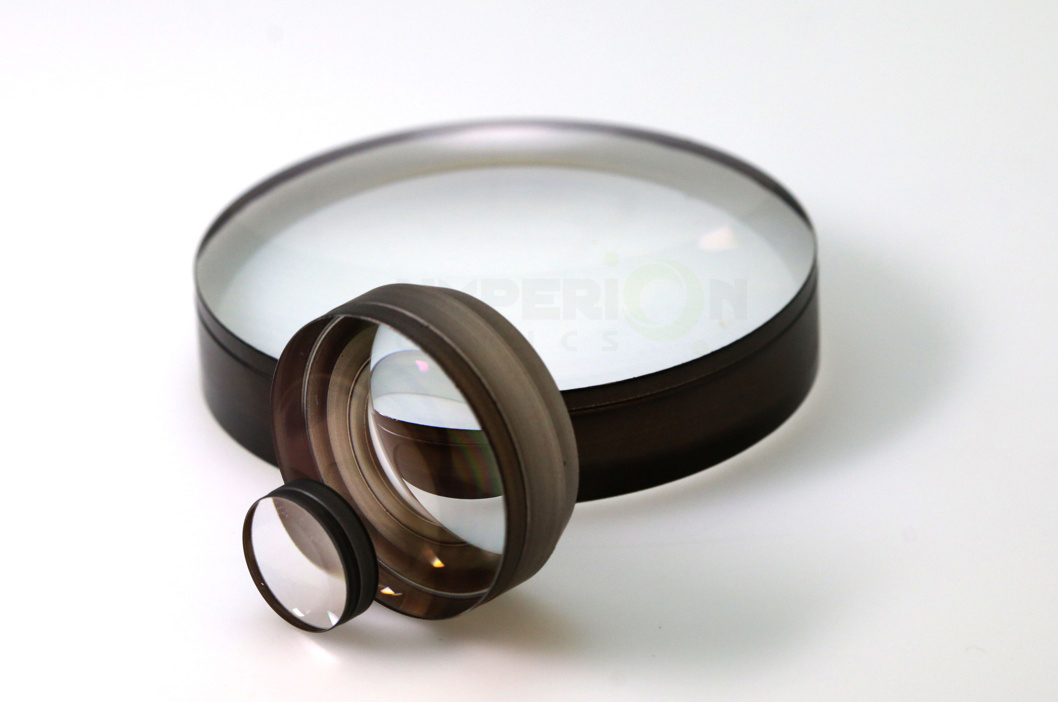
Hyperion Optics' cylindrical components have been widely used for laser based applications with reliable optical performance and durability. We are able to provide Zygo report of all cylindrical surfaces we produce, and intensive measurement can be met upon customer’s request, such as optical axis deviation.

We are working closely to innovators and photography equipment designers who develop customized anamorphic systems where use cylindrical lenses as image aspect ratio changer.

For attach-on anamorphic lenses for smart phones, anamorphic cinema projection system, and front mounted anamorphic attachment. Please check out our anamorphic lenses for more information. If you are in the stage of developing your own anamorphic lenses, don’t hesitate contacting one of our optical engineers for free consultation to receive assistant from manufacturing perspective.

At Hyperion optics, we keep utilizing optical edging technique for most demanding requirement, which is essential in cylindrical component manufacturing. We provide full inspection data along with shipment including Zygo interferometry report and centering testing results.

Achromatic cylindrical lenses are ideal for eliminating spherical and chromatic aberration at the image plane, for example using monochromatic light source, achromatic cylindrical lenses can form a 50-90% smaller spot compared to singlet.

For most severe laser or imaging applications which involve cylindrical components, such as anamorphic projection, anamorphic photography, and achromatic cylindrical lenses are introduced. Hyperion Optics can manufacture based on custom design doublet or triplet achromatic cylindrical cemented lenses by using centering alignment device with UV curing unit to process precision bonding and testing at the same time. Every singlet is fully inspected before bonding.
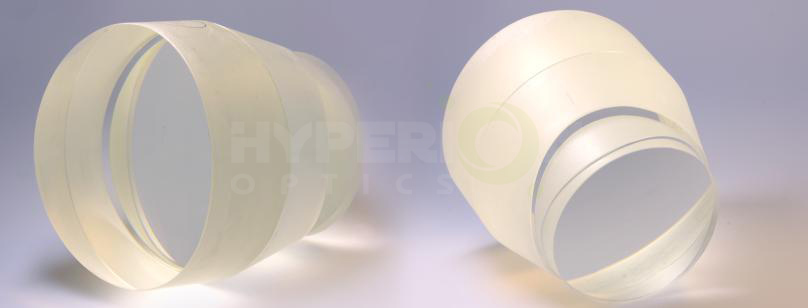
anamorphic lenses

Fresnel lenses

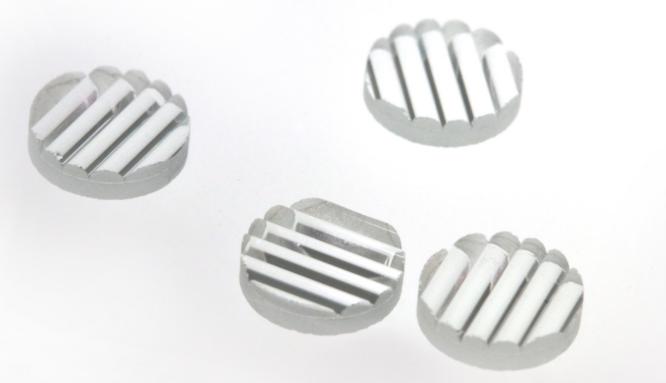
Hyperion Optics provides various fan angle line generating Fresnel lenses for laser alignment and machine vision applications. Unlike ordinary cylindrical lenses, line generating Fresnel lenses can produce uniform distribution of energy along the line.

We provide in both optical glass (N-BK7 or equivalent) and plastic version for your specific requirement. With our highly efficient cementing techniques, we support low volume customized solution and performance trial. Please note, free sampling is available upon request for all fan angle products.

Diameter varies from 4mm to 8mm, 2/2.5mm +/-0.1mm in center thickness. Fan angle available from 110°, 20°, 14°, 10°, or custom made. Our optical glass version line generating Fresnel lenses have much better imaging quality, which is also high working temperature durable. Compared to rod lenses, our products are much easier to mount.
Cylindrical lenses

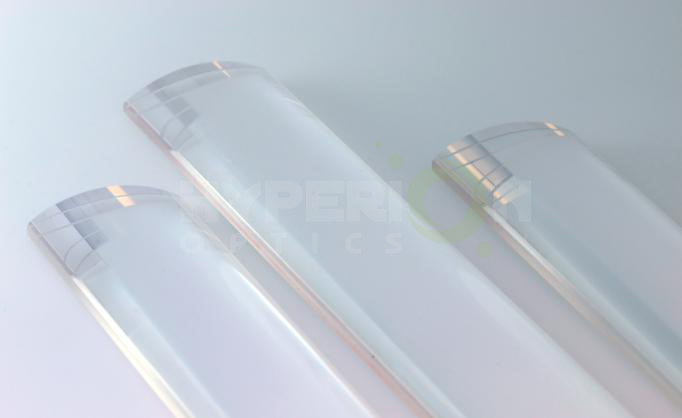
Cylindrical lenses are used to focus, expand or condense light into a single dimension. Cylindrical lenses are widely used in laser scanners, optical information processing and computing, dye lasers or anamorphic lenses. Hyperion Optics has decade of cylindrical lenses manufacturing experience, ranging from ordinary plano-convex, plano-concave to cemented achromatic cylindrical lenses.

For most laser applications, Hyperion Optics’ cylindrical lenses offer always comes with competency in price; our monthly capability is 3,000 pcs. For prototyping quantity, we provide interferometry report along with the shipment upon request.
Rod and Cone Lenses
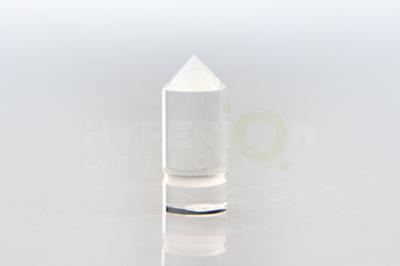
Rod lenses’ optical performance is similar to cylindrical lenses, incident collimated light passes through the polished circumference of the rod lens will be formed into a line. Variety of laser and imaging applications utilize rod lenses as line generator optics.

Hyperion Optics provides a range from micro sized rod lenses manufactured with variety of optical materials including fused silica ultra-violet version for OEM applications, also custom sizes and variations in surfaces requirement additional coatings are available upon request.

Engineers normally find that the optical uniformity varies from center to the two ends on a rod lens, Hyperion Optics insists polishing circumference on a longer length rod substrates then slice and ground the ends to tolerance to yield a better polishing result which would impact on the overall line uniformity in actual use.

Labels: , , , , ,

Thursday, May 18, 2017

Optical Lens Coating Technology and Development

In daily use, the friction with dust or grit (silicon oxide) will cause the inorganic or organic materials made glasses lens scratched the surface. Compared with the glass, the hardness of organic materials is relatively low, it is easier to be scratched. Through the microscope, we can observe the surface of the lens scratches can be divided into two types, one is caused by the gravel, shallow and small, no easy to be detected by the wearer; another is caused by the large gravel, deep and periphery rough, and it will affect the vision when it is in the central region.
 

Technical characteristics

1. The first generation wear resistant film technology
Wear resistant film began in the early 1970s. At that time the optical lenses are not easy to be ground because of its high hardness, while the organic lens is too soft and easy to wear. So they plate the quartz material on the surface of the organic form under the condition of vacuum, forming a layer of hard abrasion resistant film. But due to the mismatch of thermal expansion coefficient and the base material, it is easy to strip and the film is brittle, so wear resistant effect is not ideal.

2. The second generation wear resistant film technology
After the 1980s, the researchers found theoretically that the wear production mechanical is not only related to hardness. The coating material has dual characteristics of hardness/deformation, namely, some materials are with high hardness, but the deformation is smaller, and some materials are with low hardness, but deformation is large. The second generation of wear resistant film technology is coating a high hardness and non-fragile material on the surface of the organic lens by soaking process.

3. The third generation wear resistant film technology
The third generation of wear resistant film technology was developed in the 1990s. It is developed to solve the problem of the wear resistance of the anti-reflective coating on the organic lens. Because of the great difference between the organic lens hardness and anti-reflection film hardness, the new theory is that there is another layer of abrasion resistant coating between them, which will play a buffer role and no scratching occurs at the time of gravel friction. Between the third generation of wear resistant film material’s hardness is between anti-reflection film ‘s and lens substrate's, the friction coefficient is low and not easy to crack.

4. The fourth generation wear resistant film technology
Silicon atom is used in the fourth Fourth generation wear resistant film technology, for example, TITUS hardening liquid produced by the France Fishily company contain both organic substrates and silicon inorganic particles, makes the abrasion resistant film with the property of toughness and high hardness. The most important method of modern wear resistant film technology is immersion method, that is, after repeated cleaning, immerse the lens into plus hardening liquid for a period of time, raise up in certain speed. This rate is related to the viscosity of the hardening liquid and function decisively to the thickness of the film.  And then polymerize in the oven for about 4 to 5 hours at 100 degrees ℃, the coating thickness is about 3 - 5 microns.


Test method

1. Grinding experiment
Place the lens inside the gravel (the provisions of the size and hardness of gravel), and grind under the control. At the end of the test, measure the light ray diffuse reflection quantity using haze meter. and compared with the standard lens.

2. Steel wool test
Grind the lens a certain number times using the specified steel wood in certain pressure and velocity, and then measure the light ray diffuse reflection quantity using haze meter. and compared with the standard lens.  Of course, we can also manually grind two pieces of the lens using the same pressure with the same number of times, and then observe and compare with the naked eye.
The results of the above two methods are similar to those of the long-term clinical results.

3. The relationship between antireflection film and wear resistant film
The antireflection coating on the surface of the lens is a very thin inorganic metal oxide material (thickness less than 1 microns), hard and brittle. When the plating on the glass lens, because the base is relatively hard, gravel on it across, the film is not easy to be scratched; But if the antireflection film plated on the organic lenses, because the base is relatively soft, gravel in the coating, the film is easy to be scratched.
Therefore, in order to improve the hardness of the two kinds of coatings, it is necessary for the organic lens to be placed with the wear resistant film before the coating is reduced.

Labels: , ,

Wednesday, May 17, 2017

Pieces Knowledge: Basic Knowledge of Optical Lens Grinding Process

I. The grinding purpose and fundamental principle

1. Purpose:
(1) to remove the damaged layer of fine grinding to meet the requirements of the specified appearance limit
(2) To finish the surface, let curvature radius R circular reaches a specified value, meet the requirements of the number of NR and the local curvature of the aperture tolerance (Yasi).
2. Fundamental principle
By mechanical movement, the mechanical action will occur between the grinding agent and the glass in the grinding dish. And the purpose of precision polishing will achieve.


II. the types and use of the required dish

1 grinding dish: used for grinding lens
2 fixture: used to hold the optical lenses for fine grinding
3: relay equipment: the joint between machine and grinding dish, the height and coaxiality is adjustable.
4 dishes: used to repair the accuracy of the drill plate
5 drilling dish: it is used to correct the precision of grinding plate (drilling dish is by diamond particles curvature surface sticking into or out of shape curvature surface, its accuracy is generally +2 dish, dish 0~-1 negative, it is used for repairing and grinding the skin)

III. The main control point for grinding

1. Check the fixed points, scars, sand, broken, frog skin, corrosion on the surface or not.
2. Check the quantity of Yasi, vertical edge, the number of the surface is under the limit or not.
3. Check the grind quantity is in the within standard or not.
  • The Yasi ---- surface precision deviation image circle of confusion  (ellipse, saddle-shaped, pillar), local irregular aperture (middle part high, middle part low, vertical edge)
  • Middle part high---When the lens and the original contract fully, a small aperture will be thick, when we pull the edge,  the center will hump inward, pull 1/2, an ellipse will occur.
  • Middle part low - when the lens and the original contract fully, the center of the aperture gap is too narrow, too dense. When we pull the edge, the central bulge outward, pull 1/2, the ellipse will appear.
  • Corrosion, usually referred to as corrosion, is the appearance of a massive, punctate, fog like phenomenon caused by the chemical reaction between the surface of optical lenses and water or other substances in the air.

Achromatic Doublet Lenses

Achromatic Doublet Lens

At Hyperion Optics, with decades fabrication experiences, we have been providing our customer a vast number of achromatic lenses for their applications in different precision grades, please check our test plate radius available online for download to save your cost on custom achromatic doublet lens optical design. Particularly for cost-sensitive design, our series production capability always ensures a satisfying pricing solution.

As optical designers widely use doublets which contribute latitude to eliminate chromatic and spherical aberrations more thoroughly. We also provide excellent suggestions for glass material selection in individual design as we distinguish the importance of refractive index precision in material selection stage despite the design data in software.

Universally, with particular flint glass designers might choose, certain glass’ deliquescence attribute lead to cosmetic failure after polishing, or even affect the transmission after coating. Let us help to avoid such problem in your design to live process.


COMMERCIAL GRADE
FACTORY STANDARD
PRECISION GRADE
Diameter Tolerance(mm)
±0.05
±0.03
±0.0125
Center Thickness(mm)
±0.01
±0.03
±0.025
Radius (%)
±1%
±0.5%
±0.3%
Focal Length Tolerance (%)
±3%
±1%
±0.5%
Cosmetic(MIL-C-13830A)
100-80
40-20
10-5
Figure Tolerance in λ(Pow/irreg)
3 - 1
2 - 1/4
1 - 1/10
Centration (Arc min)
6
<3
<1
Dia. To Thick Ratio
9~50:1
Coating (T% avg)
96-98%
99%
99.5%
Materials


For extremely precision sensitive system requirement, please contact us for further information, our engineers are more than happy to evaluate your design and have our experiences of manufacturing input help to define the most appropriate tolerances.

Labels: , , , ,