Wednesday, November 8, 2017

The Application and Development of Cylindrical Lens in Modern Optoelectronic Products

The image monitoring and imaging devices currently being promoted provide us with an irreplaceable safety and comfort...
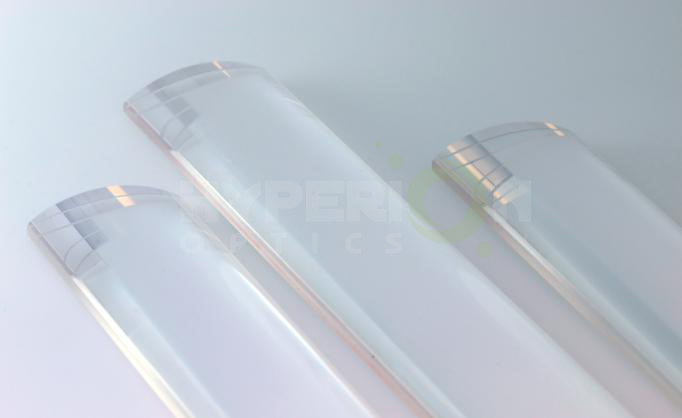
cylindrical lens 
Perhaps, while we are enjoying the convenience of optoelectronic products, we are ignoring the important components of the optoelectronic products, the cylindrical lens.

As we all know, Optoelectronic products are mostly composed of the light path system, electronics and mechanical systems. Light path system is considered to be crucial in the process of information collection and transmission. 

The optical system is composed of lenses, spectroscopes, and reflectors. The surface is usually a sphere or plane. The cylindrical lens is non-spherical, which can effectively reduce the ball difference and color difference. It is divided into flat convex cylindrical lens, flat concave cylindrical lens, double convex cylindrical lens and double concave cylindrical lens. It has one-dimensional amplification. Cylindrical lenses are designed to change the size of the image. For example, turn a spot of light into a patch or change the height of the image without changing the width. The special optical properties of the cylindrical lens make the cylindrical lens more and more widely used with the rapid development of high technology. Such as line gather system. films system. fax machines and printing typesetting scanning imaging system. And in the field of medical gastroscope. Laparoscopic, in the field of auto car video system with the participation of cylindrical lens. Linear detector at the same time in lighting, bar code scanning, holographic lighting, optical information processing, computer, laser emission. And the strong laser system and also has been widely used in synchrotron radiation beam line. At the same time, with the constant improvement of cylindrical lens processing technology, has formed a mature and effective processing technology, the quality of its good reproducibility and repeatability gradually been recognized by the market. At present, the process is gradually replacing the relatively backward traditional technology.

The cylindrical lens is known to consist of a flat and a concave (convex) surface or two concave (convex) surfaces. It can be divided into flat convex cylindrical lens, concave cylindrical lens, double convex cylindrical lens, double concave cylindrical lens, convex concave cylindrical lens. The shape is shown below:

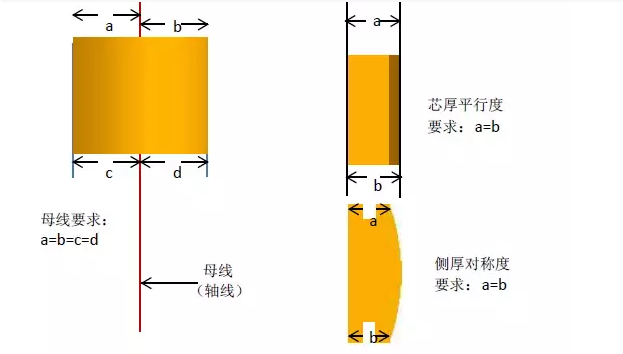

The cylindrical lens is a combination of two optical surfaces, and the relative position of two optical surfaces determines the overall optical properties of the cylindrical lens. So how to ensure the rationality of the relative position of two optical surfaces is the key and difficult point in the process of cylindrical lens. What is the ideal relationship between the two optical surfaces? Here is an example of the three views of a flat convex lens.

So in the process of cylindrical lens, if the relative position of two optical surface anomalies, common adverse project has the following kinds: (flat convex cylindrical lens, for example)

One. Bus bad


A: Bus offset: the cylindrical optic surface is offset by the cylinder axis opposite to the flat center. Here is the picture:
Causes and countermeasures:
1.The design or machine of fixture is defective, and the attached surface and the center line are not good. You need to start with the fixture.
2. The lens stick is not in place, need to be attached to the working method to begin to improve.
3. The product moves during processing. Need adhesive adhesion and processing time lens force load begin to improve.

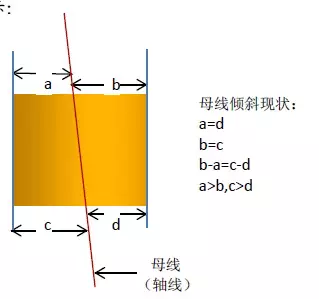
B: Bus tilt: the surface of the cylinder is tilted in a certain angle to the plane. The bus line is not parallel to the attached datum. Here is the picture:
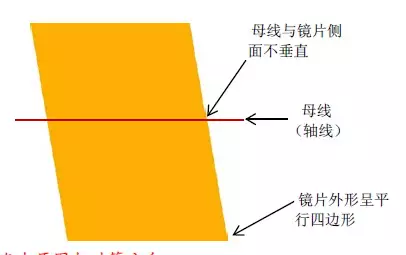

Causes and countermeasures:
1. The design or machine of fixture is defective, the surface of the lens is attached to the axis of the central axis and the failure of the channel is not good. You need to start with the fixture.
2. The lens stick is not in place, need to be attached to the working method to begin to improve.

Two. The bus is perpendicular to the line

Causes and countermeasures:
1. The design or machine of fixture is defective, and the two benchmarks are not straight. You need to start with the fixture.
2. The lens stick is not in place, need to be attached to the working method to begin to improve.
3. The cutting machine is not accurate, and the main shaft and the desktop are in the wrong angle. It is necessary to improve the machining accuracy. In accordance with stated in, cylinder lens bus location plays an important role in the optical performance, then the bus in addition to guarantee in the process of machining, in the test link is also very important. Here's a new way to detect a cylindrical lens:

Point laser reflection detector
Principle:
Using a laser generator through a special lens will be test cylinder lens, the light source into cylindrical lens by cylinder after receives the light source the light source is reflected back to image receiver, again by the CCD camera images appear on the display equipment. The final judgment is made by the testers.

Advantages:
High detection accuracy: the detection error can be controlled in 0.001 mm.
High detection efficiency: the skilled person can detect 20PCS per minute.
Do not affect the appearance: using laser reflection to detect has no direct contact to the surface of the product and to the product appearance does not have the effect.
New process of cylindrical lens processing
For a long time, most of the domestic cylindrical mirror manufacturing has been used in the traditional way of processing. It gradually failed to meet customers' needs. Our company is based on many years of lens processing experience, and study abroad advanced processing technology, the development of a set of advanced cylindrical lens to process the new method. This method changes the traditional single chip processing to make the plate processing, greatly improve the processing efficiency, and can reduce the processing cost. The stability of processing quality also increased significantly.

Labels: , , , , , ,

The Use of Cylindrical Lens

Cylindrical Lens can be used in a single axial convergence or divergence of the beam and found in optical measurement, laser scanning, spectroscopy, laser diode output beam shaping, the X-ray light microscopic imaging, and many other industries and fields have a wide range of applications.

Turn the quasi-direct light source into the line light source
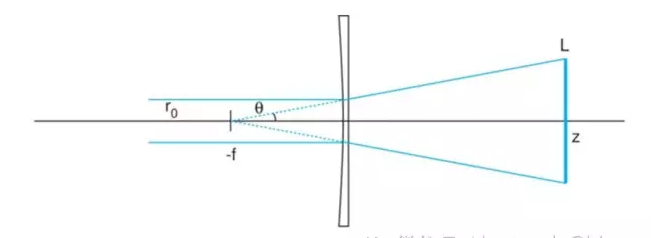
L = 2(r0/f)(z+f)

It is the most extensive application of cylindrical lens. As shown in the figure below, The quasi-direct light source with radius r0 is irradiated into a concave cylindrical lens with a focal length of -f(The image is in order to illustrate the principle more clearly, so amplify the beam radius). The beam will diverge in half theta (theta = r0 / f). At this point, it can also be approximated as the divergence of the point source at the focal point -f. The distance to the back of the lens is z. The width of the line beam is 2r0 (ignoring the divergence of the  Gaussian-distributed beam spot), but the length of the line beam is changed
L = 2 (r0 / f) (z + f)
When z is greater than f, the expansion ratio approaches z/f, and the length of the line is proportional to z.


application of cylindrical lens


If need in the z produces width is very narrow line light source, can be in the plane concave cylindrical lens front end or back end of a flat convex cylindrical lens focal length for z, with the orthogonal plane concave cylindrical lens place, to compress the beam width.

【 Quick Start】The focus and alignment of light

The diode outputs beam of collimation
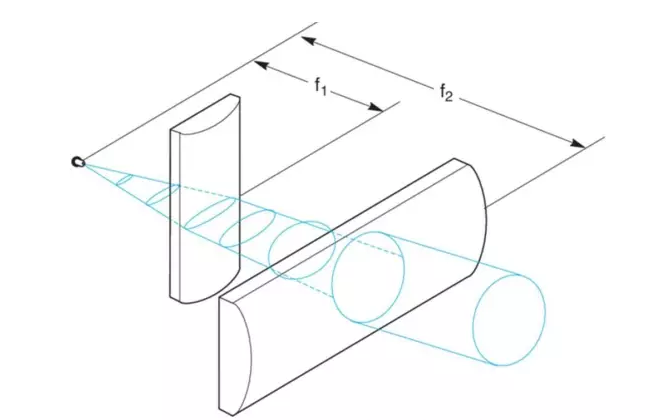
The laser diode output beam diverges in an asymmetric form, and its quasi-direct work is more challenging. for example, to divergence angle theta. Theta 1 x 2 = 10 ° x 40 ° diode light source, if only use the standard spherical lens, and only in a single direction on collimating, another direction divergence or convergence will happen. Using a cylindrical lens that the problem is decomposed into two one-dimensional directions, through the combination of two orthogonal cylinder lens, two directions can be collimated at the same time.


The selection of the cylindrical lens and the installation of the light road should follow the below rules:
θ1/θ2 = 10°/40° = f1/f2

1)To make the spot symmetrical after the adjustment, the focal length ratio of the two cylindrical lenses is equivalent to the divergence angle.
Theta 1 / theta 2 = 10°/ 40° = f1 / f2

2)The laser diode can be approximated as a point source, to get the collimating output, The spacing between the two cylinders and the light source is equal to the focal length of the two.

3)The spacing between the main planes of the two cylinders should be equal to the difference between the focal length of the f2-f1, and the actual spacing between the two lenses is equal to BFL2 - BFL1. Like the spherical lens, the convex side of a cylindrical mirror should be directed toward a quasi-direct beam to minimize as much as possible.
d1 = 2f1(tan(θ2/2))
d2 = 2f2(tan(θ1/2))

4)Because the laser diode output beam diverges faster, we need to be careful to confirm that the spot size on each cylinder is no longer than the effective light aperture of the lens. Because the distance of the cylinder is equal to its focal length, the maximum spot width of each cylinder should be followed
D1 = 2f1 (theta 2/2)
D2 is equal to 2f2, the tangent of theta one half.

For example, Newport CKX012 (f1 = 12.7 mm, BFL1 = 7.49 mm) and CKX050 (f2 = 50.2 mm, BFL2 = 46.03 mm) the combination of cylinder lens, the spacing between the two lens on the plane for BFL2 - BFL1 = 38.54 mm. The diameter of the spot in the first cylindrical lens is
D1 = 2 (12.7 mm) tan (20 °) = 9.2 mm
The diameter of the light spot in the second cylinder is
D2 = 2 (50.2 mm) tan (5 °) = 8.8 mm

Although there is still a little asymmetry, the simple combinations of these two cylindrical lenses have greatly improved the quality of the beams.

Hyperion Optics’ cylindrical components have been widely used for laser based applications with reliable optical performance and durability. We are able to provide Zygo report of all cylindrical surfaces we produce, and intensive measurement can be met upon customer’s request, such as optical axis deviation.

We are working closely to innovators and photography equipment designers who develop customized anamorphic systems where use cylindrical lenses as image aspect ratio changer.

For attach-on anamorphic lenses for smart phones, anamorphic cinema projection system, and front mounted anamorphic attachment. Please check out our anamorphic lenses for more information. If you are in the stage of developing your own anamorphic lenses, don’t hesitate contacting one of our optical engineers for free consultation to receive assistant from manufacturing perspective.

At Hyperion optics, we keep utilizing optical edging technique for most demanding requirement, which is essential in cylindrical component manufacturing. We provide full inspection data along with shipment including Zygo interferometry report and centering testing results.

Cylindrical lenses

Cylindrical lenses are used to focus, expand or condense light into a single dimension. Cylindrical lenses are widely used in laser scanners, optical information processing and computing, dye lasers or anamorphic lenses. Hyperion Optics has decade of cylindrical lenses manufacturing experience, ranging from ordinary plano-convex, plano-concave to cemented achromatic cylindrical lenses.

For most laser applications, Hyperion Optics’ cylindrical lenses offer always comes with competency in price; our monthly capability is 3,000 pcs. For prototyping quantity, we provide interferometry report along with the shipment upon request.

Hyperion Optics

In addition, Hyperion Optics has been working closely to innovators and photography equipment designers who develop customized anamorphic systems where use cylindrical lenses as image aspect ratio changer, such as attach-on anamorphic lenses for smart phones, anamorphic cinema projection system, and front mounted anamorphic attachment. Please check out our anamorphic lenses for more information. If you are in the stage of developing your own anamorphic lenses, don’t hesitate contacting one of our optical engineers for free consultation to receive assistant from manufacturing perspective.

At Hyperion optics, We keep utilizing optical edging technique for most demanding requirement, which is essential in cylindrical component manufacturing. We provide full inspection data along with shipment including Zygo interferometry report and centering testing results.

Cylindrical Lenses
COMMERCIAL GRADE
FACTORY STANDARD
PRECISION GRADE
Size Tolerance Length/Width(mm)
+0/-0.30
+0/-0.25
+0/-0.25
Diameter (mm)
+0/-0.15
+0/-0.10
±0.025
Wedge (along axis)
5 mrad
3 mrad
1 mrad
Focal Length Tolerance (%)
±2%
±2%
±1%
Cosmetic(MIL-C-13830A)
80-50
60-40
10-5
Irregularity (Lambda @ 632.8nm)
1 L
1/2 L
1/10 L
Centration (Arc min)
<5'
<3'
<1'
Coating (T% avg)
99%
99.5%
99.5%
Materials
Optical Glasses Depends On Design

Labels: , , , , , , ,

Laser Optics - White Light Laser and its Application

The existing laser technology has always had a short board, which can only emit light of a single wavelength or narrow band. How to expand the frequency of the laser forming ultra broadband, super straight, ultraviolet, visible and infrared wavelengths of coherent white light laser, is still a human unfulfilled dream, it is a worldwide problem of science and technology. This is because the laser optics is composed of optical resonator, gain medium and pump source. The wavelength of the laser is determined by the energy level structure of the atoms, molecules or ions in the gain substance.
Because the natural laser crystal material has a great limitation on the gain frequency range and gain bandwidth, the laser can't produce any wavelength of laser.
Will the perfect white laser be created? What changes and developments could it bring to the application of lasers?

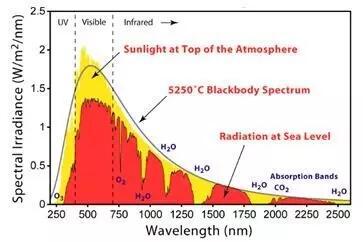
1. The sun light

It is known to all that all things grow by the sun, and the sunlight brings light and heat to the earth. The familiar sunlight is a kind of white light, and its spectrum covers ultraviolet - visible - near infrared - mid-infrared bands, as shown in figure 1, In the visible light band (400-700 nm), the radiation energy is strongest, covering seven colors of red, orange, yellow, green and blue, and continuous distribution and transition in the spectrum. Because the sun is white, rainbows are often seen in the sky after rain, or the sunlight passes through a glass prism through seven colors of light (figure 2). This is a common experience in everyday life.

One of the things that people are less familiar with is that sunlight is a completely incoherent light. In terms of spatial coherence, the sunlight cannot be straight and highly divergent. In terms of temporal coherence, there is no phase correlation and locking between different colors of sunlight. So sunlight can only be used to generate energy for heating, water heaters, solar cells and so on.
But the use of modern science and technology, such as the use of sunlight to transmit information, seems to be out of the question.

laser
The spectral distribution of sunlight. The spectrum of solar radiation including the sun itself, the spectrum of sunlight entering the earth, and the spectrum of sunlight reaching the sea level due to the absorption of atmospheric water and carbon dioxide. 

2. The advantages and application prospect of white light laser

White light laser light source, short wave laser light sources and continuous laser light compared with the ordinary white light, such as sunlight, incandescent lamp, white LED lamp, etc.), it has the advantages of high brightness, high peak power, wide frequency range etc. In the fields of scientific research, defense military, lighting, communication technology, information technology, industrial production, biomedicine, environmental detection, etc.it got a lot of attention.

White light, as a kind of new laser light source, it has a variety of advantages of good directionality, high energy density, super continuous spectrum, great bandwidth, the center of the flexible wavelength, high degree of coherence time and space. This will greatly expand the function and application scope of laser technology. The white light laser or the solar laser is the completely coherent light, not only the height of the laser beam, but also the very small region. Different color between amplitude and phase locking completely, by regulating the amplitude and phase, it can change the time of laser pulse shape follow one's inclinationsly, and produce very short pulse width (femtosecond and the femtosecond laser pulses. Such a solar laser will have the potential to realize the focus and convergence of light energy in space and time. It releases energy in small areas and very short periods of time to form extremely high instantaneous power density.

Labels: , , ,

Wednesday, September 6, 2017

Cylindrical Lenses for customizition

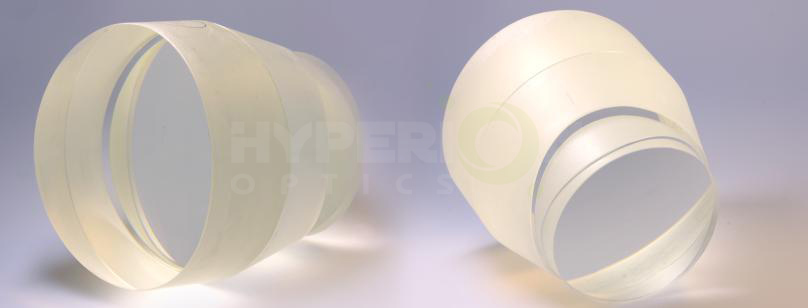
Hyperion Optics' cylindrical components have been widely used for laser based applications with reliable optical performance and durability. We are able to provide Zygo report of all cylindrical surfaces we produce, and intensive measurement can be met upon customer’s request, such as optical axis deviation.

We are working closely to innovators and photography equipment designers who develop customized anamorphic systems where use cylindrical lenses as image aspect ratio changer.

For attach-on anamorphic lenses for smart phones, anamorphic cinema projection system, and front mounted anamorphic attachment. Please check out our anamorphic lenses for more information. If you are in the stage of developing your own anamorphic lenses, don’t hesitate contacting one of our optical engineers for free consultation to receive assistant from manufacturing perspective.

At Hyperion optics, we keep utilizing optical edging technique for most demanding requirement, which is essential in cylindrical component manufacturing. We provide full inspection data along with shipment including Zygo interferometry report and centering testing results.

Achromatic cylindrical lenses are ideal for eliminating spherical and chromatic aberration at the image plane, for example using monochromatic light source, achromatic cylindrical lenses can form a 50-90% smaller spot compared to singlet.

For most severe laser or imaging applications which involve cylindrical components, such as anamorphic projection, anamorphic photography, and achromatic cylindrical lenses are introduced. Hyperion Optics can manufacture based on custom design doublet or triplet achromatic cylindrical cemented lenses by using centering alignment device with UV curing unit to process precision bonding and testing at the same time. Every singlet is fully inspected before bonding.

anamorphic lenses

Fresnel lenses

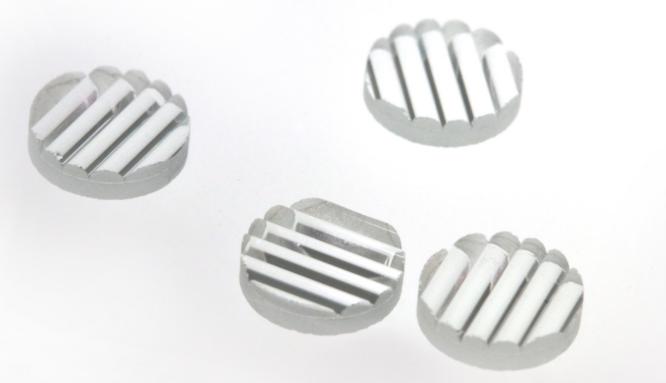
Hyperion Optics provides various fan angle line generating Fresnel lenses for laser alignment and machine vision applications. Unlike ordinary cylindrical lenses, line generating Fresnel lenses can produce uniform distribution of energy along the line.

We provide in both optical glass (N-BK7 or equivalent) and plastic version for your specific requirement. With our highly efficient cementing techniques, we support low volume customized solution and performance trial. Please note, free sampling is available upon request for all fan angle products.

Diameter varies from 4mm to 8mm, 2/2.5mm +/-0.1mm in center thickness. Fan angle available from 110°, 20°, 14°, 10°, or custom made. Our optical glass version line generating Fresnel lenses have much better imaging quality, which is also high working temperature durable. Compared to rod lenses, our products are much easier to mount.

Cylindrical lenses

Cylindrical lenses are used to focus, expand or condense light into a single dimension. Cylindrical lenses are widely used in laser scanners, optical information processing and computing, dye lasers or anamorphic lenses. Hyperion Optics has decade of cylindrical lenses manufacturing experience, ranging from ordinary plano-convex, plano-concave to cemented achromatic cylindrical lenses.

For most laser applications, Hyperion Optics’ cylindrical lenses offer always comes with competency in price; our monthly capability is 3,000 pcs. For prototyping quantity, we provide interferometry report along with the shipment upon request.

Rod and Cone Lenses
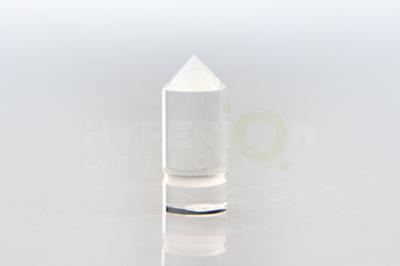
Rod lenses’ optical performance is similar to cylindrical lenses, incident collimated light passes through the polished circumference of the rod lens will be formed into a line. Variety of laser and imaging applications utilize rod lenses as line generator optics.

Hyperion Optics provides a range from micro sized rod lenses manufactured with variety of optical materials including fused silica ultra-violet version for OEM applications, also custom sizes and variations in surfaces requirement additional coatings are available upon request.

Engineers normally find that the optical uniformity varies from center to the two ends on a rod lens, Hyperion Optics insists polishing circumference on a longer length rod substrates then slice and ground the ends to tolerance to yield a better polishing result which would impact on the overall line uniformity in actual use.

Labels: , , , , ,

Infrared Lenses

We work on a wide range of infrared materials that covers almost full infrared spectrum. Hyperion Optics supplies Zinc Selenide, Zinc Sulfide, Silicon, Germanium, Gallium Arsenide, and Calcium Fluoride, Barium Fluoride as well as Chalcogenide spherical lenses and aspherical lenses. We use laser based edging device to control MWIR and LWIR lenses’ decenter deviation, and test on reflective centering station to fulfill extreme precise tasks.

Zinc Selenide has great transmittance through the band 0.5-22μm, especially at 10.6μm, and is commonly used in thermal imaging and FLIR systems, also its outstanding low absorption coefficient and high resistance to thermal shock makes it an ideal choice for high power CO2 laser applications. For laser ZnSe components please browse our Laser Optics category for more information.

Since Zinc Selenide is a relatively soft material that scratches and digs can be easily remained on the surfaces during processing flow, it is not recommended for use within harsh environments, Hyperion Optics’ advanced manufacturing techniques for ZnSe ensure superior surface quality compared to our competitors. For cosmetic sensitive systems, our best effort can reach 20-10 in S/D grade. ZnSe aspheric lenses are also available for your application; please refer to IR Aspheric Lenses for more information. ZnSe Dome optics are also available in our Dome category.


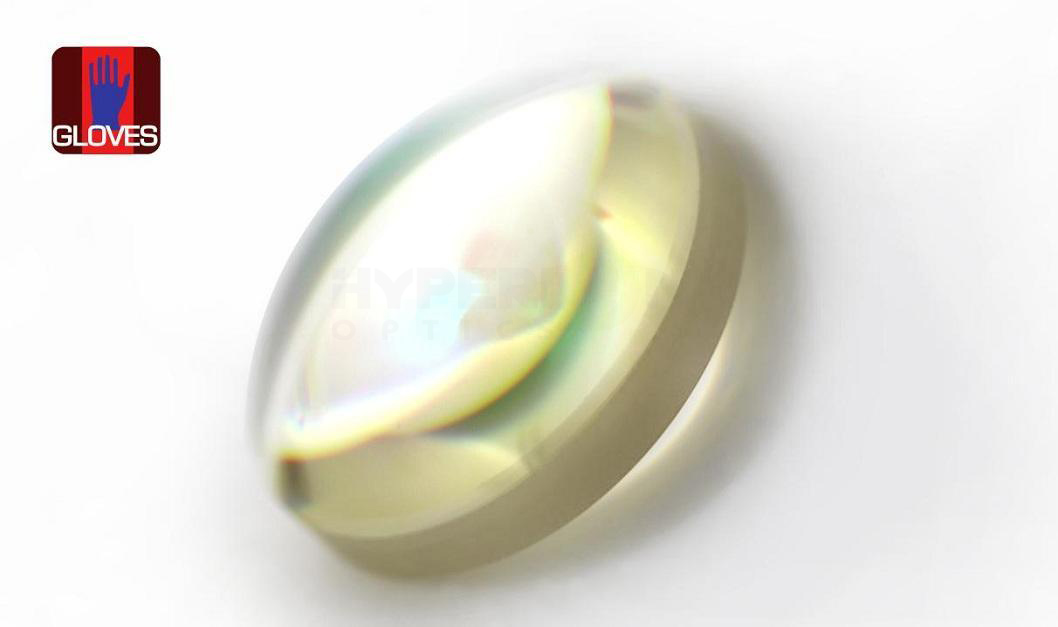
Our infrared lenses are also available with AR coating according to specific requirement. Please take great care when handling, mounting and cleaning infrared lenses, further, For your safety, please follow all proper precautions, including wearing gloves when handling these lenses and thoroughly washing your hands afterward.

In addition, along with our outstanding aspherical (including DOE surface) manufacturing capability, Hyperion Optics is definitely one of your best choices in SWIR/MWIR/LWIR lenses development project.

Types of infrared lenses:

Chalcogenide Lenses
Barium Fluoride Lenses
Calcium Fluoride Lenses
Magnesium Fluoride Lenses
Gallium Arsenide Lenses
Germanium Lenses
Sapphire Lenses
Silicon Lenses
Zinc Selenide Lenses
Zinc Sulfide Lenses

Take two as examples:

Chalcogenide Lenses

Chalcogenide glass is containing one or more chalcogens (sulfur, selenium and tellurium, but excluding oxygen). Chalcogenide components are becoming popular in various IR applications due to its excellent wide band transmittance (3-5µm, 8-12µm) with reliable machinability, which perform rather differently from oxides; particularly low band gaps help optical designers to introduce more flexible IR solutions.

Zinc Sulfide Lenses


Based on Hyperion Optics' IR material processing capability, we now introduce our Chalcogenide glass family components, as equipped with the most advanced manufacturing devices, Hyperion Optics is able to deliver quality Chalcogenide components just like other IR materials. Our Chalcogenide material inventory ranges from Schott IRG22, IRG23, IRG24, IRG25, IRG26; in addition, as our partnership with China based material vendor HUBEI NEW HUAGUANG (Known as NHG) Material Technology Co., Ltd,. We also supply Chalcogenide components with their Chinese equivalents which is a highly cost-effective solution for our potential customer whether it is a concept approval project or series production scenario.

With the rapid development of military weaponry and correlative targeting and monitoring systems, ZnS is widely utilized in multi-spectral IR applications. Its relatively high transmittance through 3-5µm and 8-10µm enable ZnS being an ideal choice for multi-spectral applications. Further, within NIR and SWIR range, CLEARTRAN CVD ZnS can also be considered as indispensable alternative for optical designers.

Labels: , , , , , , , ,

What is optical filters

Fluorescence filter is a fluorescence imaging filter for biomedical and life science instruments, the key components, the main role is in the biomedical fluorescence analysis system for the separation and selection of substances in the excitation and emission fluorescence Of the spectral characteristics of the band. It is usually required that the filter cut-off depth be greater than OD5 (optical density, OD = -lgT). The core requirements for filters used in fluorescence detection systems are high cut-off steepness, high transmittance, high positioning accuracy, high cut-off depth, and excellent environmental stability.

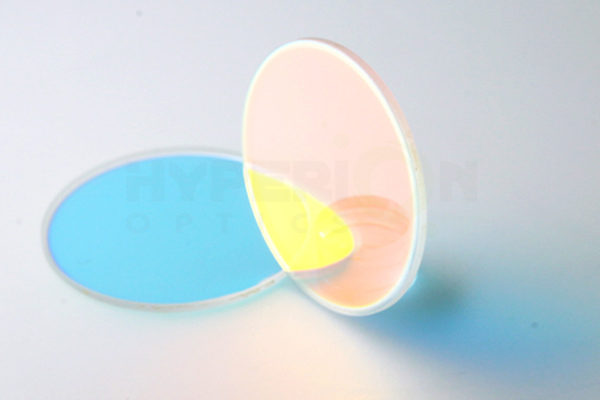
Fluorescence filter is a combination of three, three are excitation filters, emission filters and dichroic filters.

Excitation Filter (Exciter Filter, Excitation Filter, Excitation Filter): In the fluorescence microscope, only the excitation wavelength of the filter can pass through the fluorescence. In the past, a short-pass filter was used, and now a band-pass filter is basically used. The housing is marked with arrows indicating the direction of propagation of the recommended light.

Emission Filter (Emitter Filter, Emitter): Select and transmit the fluorescence emitted by the sample, the other range of light cut-off. The wavelength of the emitted light is longer than the wavelength of the excitation light (closer to red). A band-pass filter or a long-wave-pass filter may be selected as the emission filter. The housing is marked with arrows indicating the direction of propagation of the recommended light.

Dichroic Mirror (Dichromic Beamsplitter, Dichromatic Beamsplitter): also known as dichroic mirrors or dichroic mirrors. And placed at an angle of 45 ° to the optical path of the microscope. This filter reflects one color of light (excitation light) and transmits another color of light (emitted light), the reflectivity of the excitation light is greater than 90% and the transmittance of the emitted light is greater than 90%. The impervious portion of the spectrum is reflected rather than absorbed. Filter in the transmitted light and reflected light color complement each other, and thus also known as dichroic filters.

Our optical filters are designed for fluorescence imaging applications, with durability in mind and high-performance optical specifications in manufacturing. The filter substrate is made of quartz, which can achieve 1/10 lambda surface accuracy, while the thermal expansion coefficient of quartz is relatively small, can obtain higher image quality.

We equipped with 4 coating chambers to provide various filters to our customers. For custom specifications, please talk to our coating engineers, we are more than happy to simulate the coating result for you. Contact us today, and find out our coating capability for your needs.

Bandpass Filter
Band pass filter can separate a band of monochromatic light, the ideal transmittance of band-pass filter through the bandwidth is 100%, while the actual band-pass filter pass band is not the ideal square. The actual band-pass filter generally has a center wavelength λ0, a transmittance T0, a half width of the pass band (FWHM, a distance between two positions where the transmittance in the pass band is half the peak transmittance), the cutoff range and other key parameters to describe.

Multichannel Filter
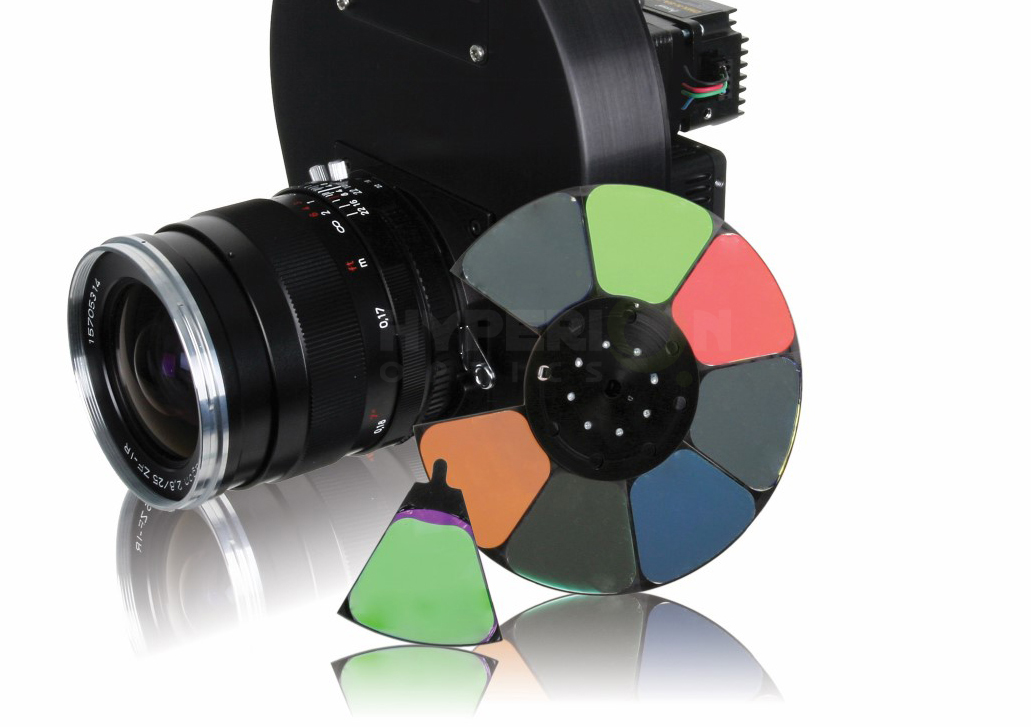
Multichannel filters differ from conventional bandpass filters by allowing only one continuous band of light to pass through it, allowing two or more bands of light to pass through.

Multi-channel filters can be achieved on a filter to achieve the need for multiple general filter stack to achieve the effect, making the design more compact, and can reduce costs.

This filter in the optical communications, infrared and medical applications have a wide range.

Neutral Density Filter

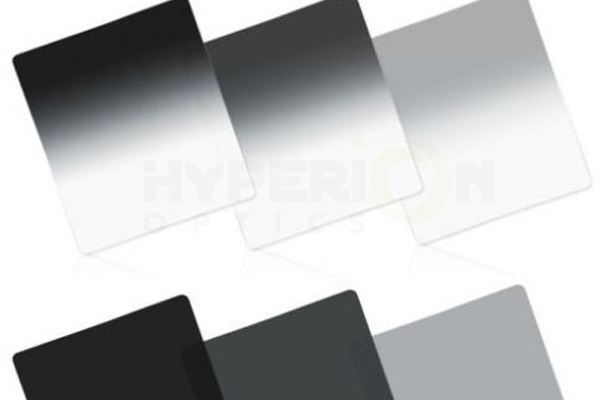
Neutral gray-scale filter is a non-selective filter, that is, ND mirror for a variety of different wavelengths of light to reduce the capacity is the same, uniform, only to weaken the role of light, and The original color of the object will not have any impact, so you can reproduce the real scene contrast.

The main purpose of using ND mirrors is to prevent over-exposure.

For example, when you want to extend the exposure time when the light is strong, use the ND lens to reduce the light entering the lens, you can use a slower shutter shot. For example, in the daytime when the light is strong with slow shutter speed to capture the waterfall to show the virtual effects of water and other special effects, you need ND mirror.

Labels: , , , , , , , ,