Wednesday, November 8, 2017

The Use of Cylindrical Lens

Cylindrical Lens can be used in a single axial convergence or divergence of the beam and found in optical measurement, laser scanning, spectroscopy, laser diode output beam shaping, the X-ray light microscopic imaging, and many other industries and fields have a wide range of applications.

Turn the quasi-direct light source into the line light source
L = 2(r0/f)(z+f)

It is the most extensive application of cylindrical lens. As shown in the figure below, The quasi-direct light source with radius r0 is irradiated into a concave cylindrical lens with a focal length of -f(The image is in order to illustrate the principle more clearly, so amplify the beam radius). The beam will diverge in half theta (theta = r0 / f). At this point, it can also be approximated as the divergence of the point source at the focal point -f. The distance to the back of the lens is z. The width of the line beam is 2r0 (ignoring the divergence of the  Gaussian-distributed beam spot), but the length of the line beam is changed
L = 2 (r0 / f) (z + f)
When z is greater than f, the expansion ratio approaches z/f, and the length of the line is proportional to z.
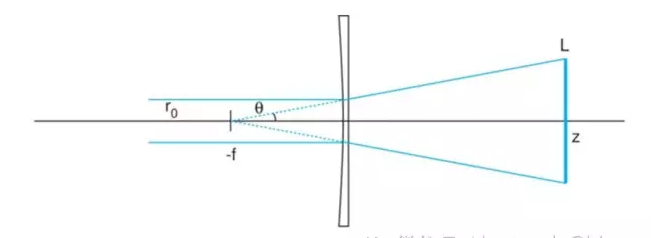

application of cylindrical lens


If need in the z produces width is very narrow line light source, can be in the plane concave cylindrical lens front end or back end of a flat convex cylindrical lens focal length for z, with the orthogonal plane concave cylindrical lens place, to compress the beam width.

【 Quick Start】The focus and alignment of light

The diode outputs beam of collimation
The laser diode output beam diverges in an asymmetric form, and its quasi-direct work is more challenging. for example, to divergence angle theta. Theta 1 x 2 = 10 ° x 40 ° diode light source, if only use the standard spherical lens, and only in a single direction on collimating, another direction divergence or convergence will happen. Using a cylindrical lens that the problem is decomposed into two one-dimensional directions, through the combination of two orthogonal cylinder lens, two directions can be collimated at the same time.
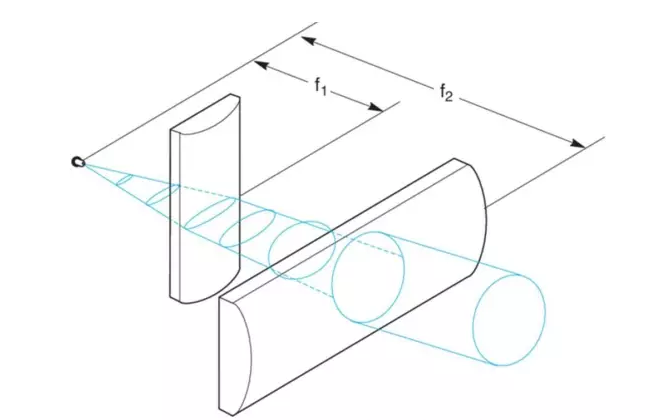


The selection of the cylindrical lens and the installation of the light road should follow the below rules:
θ1/θ2 = 10°/40° = f1/f2

1)To make the spot symmetrical after the adjustment, the focal length ratio of the two cylindrical lenses is equivalent to the divergence angle.
Theta 1 / theta 2 = 10°/ 40° = f1 / f2

2)The laser diode can be approximated as a point source, to get the collimating output, The spacing between the two cylinders and the light source is equal to the focal length of the two.

3)The spacing between the main planes of the two cylinders should be equal to the difference between the focal length of the f2-f1, and the actual spacing between the two lenses is equal to BFL2 - BFL1. Like the spherical lens, the convex side of a cylindrical mirror should be directed toward a quasi-direct beam to minimize as much as possible.
d1 = 2f1(tan(θ2/2))
d2 = 2f2(tan(θ1/2))

4)Because the laser diode output beam diverges faster, we need to be careful to confirm that the spot size on each cylinder is no longer than the effective light aperture of the lens. Because the distance of the cylinder is equal to its focal length, the maximum spot width of each cylinder should be followed
D1 = 2f1 (theta 2/2)
D2 is equal to 2f2, the tangent of theta one half.

For example, Newport CKX012 (f1 = 12.7 mm, BFL1 = 7.49 mm) and CKX050 (f2 = 50.2 mm, BFL2 = 46.03 mm) the combination of cylinder lens, the spacing between the two lens on the plane for BFL2 - BFL1 = 38.54 mm. The diameter of the spot in the first cylindrical lens is
D1 = 2 (12.7 mm) tan (20 °) = 9.2 mm
The diameter of the light spot in the second cylinder is
D2 = 2 (50.2 mm) tan (5 °) = 8.8 mm

Although there is still a little asymmetry, the simple combinations of these two cylindrical lenses have greatly improved the quality of the beams.

Hyperion Optics’ cylindrical components have been widely used for laser based applications with reliable optical performance and durability. We are able to provide Zygo report of all cylindrical surfaces we produce, and intensive measurement can be met upon customer’s request, such as optical axis deviation.

We are working closely to innovators and photography equipment designers who develop customized anamorphic systems where use cylindrical lenses as image aspect ratio changer.

For attach-on anamorphic lenses for smart phones, anamorphic cinema projection system, and front mounted anamorphic attachment. Please check out our anamorphic lenses for more information. If you are in the stage of developing your own anamorphic lenses, don’t hesitate contacting one of our optical engineers for free consultation to receive assistant from manufacturing perspective.

At Hyperion optics, we keep utilizing optical edging technique for most demanding requirement, which is essential in cylindrical component manufacturing. We provide full inspection data along with shipment including Zygo interferometry report and centering testing results.
Cylindrical lenses

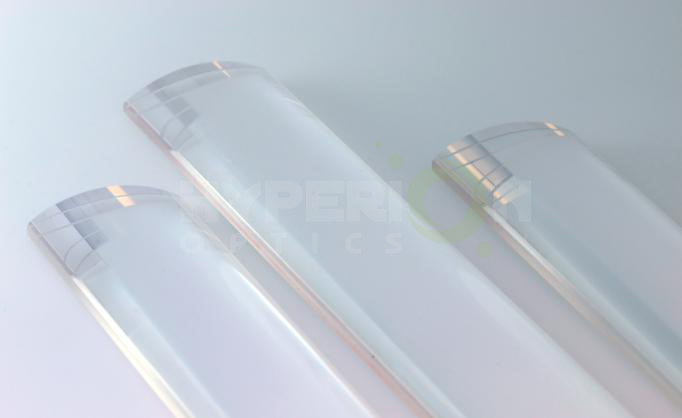
Cylindrical lenses are used to focus, expand or condense light into a single dimension. Cylindrical lenses are widely used in laser scanners, optical information processing and computing, dye lasers or anamorphic lenses. Hyperion Optics has decade of cylindrical lenses manufacturing experience, ranging from ordinary plano-convex, plano-concave to cemented achromatic cylindrical lenses.

For most laser applications, Hyperion Optics’ cylindrical lenses offer always comes with competency in price; our monthly capability is 3,000 pcs. For prototyping quantity, we provide interferometry report along with the shipment upon request.
Hyperion Optics

In addition, Hyperion Optics has been working closely to innovators and photography equipment designers who develop customized anamorphic systems where use cylindrical lenses as image aspect ratio changer, such as attach-on anamorphic lenses for smart phones, anamorphic cinema projection system, and front mounted anamorphic attachment. Please check out our anamorphic lenses for more information. If you are in the stage of developing your own anamorphic lenses, don’t hesitate contacting one of our optical engineers for free consultation to receive assistant from manufacturing perspective.

At Hyperion optics, We keep utilizing optical edging technique for most demanding requirement, which is essential in cylindrical component manufacturing. We provide full inspection data along with shipment including Zygo interferometry report and centering testing results.

Cylindrical Lenses
COMMERCIAL GRADE
FACTORY STANDARD
PRECISION GRADE
Size Tolerance Length/Width(mm)
+0/-0.30
+0/-0.25
+0/-0.25
Diameter (mm)
+0/-0.15
+0/-0.10
±0.025
Wedge (along axis)
5 mrad
3 mrad
1 mrad
Focal Length Tolerance (%)
±2%
±2%
±1%
Cosmetic(MIL-C-13830A)
80-50
60-40
10-5
Irregularity (Lambda @ 632.8nm)
1 L
1/2 L
1/10 L
Centration (Arc min)
<5'
<3'
<1'
Coating (T% avg)
99%
99.5%
99.5%
Materials
Optical Glasses Depends On Design

Labels: , , , , , , ,

Wednesday, September 6, 2017

What is optical mirror

Optical Mirrors are designed to reflect light for a variety of applications, including beam steering, interferometry, imaging, or illumination. Optical Mirrors are used in a wide range of industries, such as life sciences, astronomy, metrology, semiconductor, or solar.

Hyperion Optics offers a range of laser, flat, metal substrate, focusing, or specialty Optical Mirrors in a multitude of reflective coating options, including Protected Aluminum, Enhanced Aluminum, Protected Silver, Protected Gold, or Dielectric. Choosing the proper reflective coating option ensures high reflectivity of the needed wavelength or wavelength range. Optical Mirrors designed for laser applications are optimized for the given laser wavelength. Additionally, Optical Mirrors designed for lasers feature damage thresholds that are suitable for the designated laser. Metal substrate Optical Mirrors are ideal for applications requiring a constant coefficient of thermal expansion between the Optical Mirror and the mount. Optical Mirrors with a concave surface are ideal for light focusing applications.

Optical mirrors have a smooth, highly-polished, plane or curved surface for reflecting light. Usually, the reflecting surface is a thin coating of silver, or aluminum on glass. Product specifications for optical mirrors include diameter, radius of curvature, thickness focal length, and surface quality. The diameter or height of an optical mirror is measured straight on. If the optical mirror’s curvature was extrapolated into a sphere, then the radius of that sphere is the radius of curvature for the mirror. There are two thickness measurements for optical mirrors: center thickness and edge thickness. Units of measure include inches, feet, and yards; nanometers, centimeters, and millimeters, and miles and kilometers. With optical mirrors, focal length is the distance from the mirror at which light converges. Surface quality describes digs and scratches. A dig is a defect on a polished optical surface that is nearly equal in terms of length and width. A scratch is a defect whose length is many times its width.

Optical mirrors are made from many different materials, each of which influences the mirror’s reflectivity characteristics. Choices for materials include borosilicate glass, copper, fused silica, nickel, and optic crown glass. Borosilicate glass is also known as BK7 and boro-crown glass. Copper is used in high-power applications because of its high thermal conductivity. Fused silica has a very low coefficient of thermal expansion and is suitable for use with moderately-powered lasers or changing environmental conditions. Ultraviolet (UV) grade optical mirrors are also commonly available. Nickel is used in applications which require resistance to both thermal and physical damage. Proprietary materials for optical mirrors include Pyrex (Corning Inc.) and Zerodur (Schott Glaswerke).

Optical mirrors are sometimes coated to enhance their reflectivity. Choices include bare, enhanced, and protected aluminum; silver, bare gold and protected gold; and coatings made from rhodium and dielectric materials. Enhanced aluminum coatings are used to improve reflectance in the visible and ultraviolet regions. Protected aluminum coatings provide abrasion resistance while protecting the surface of the aluminum, an excellent reflector in the upper UV, visible and near-infrared (IR) regions. Optical mirrors with bare gold and protected gold coatings are used in the near-IR to far-IR regions. Silver coatings provide better reflectance than aluminum; however, silver’s tendency to oxidize and tarnish requires thorough sealing from the atmosphere. Rhodium coatings have a reflectivity of approximately 80% of the visible spectrum.


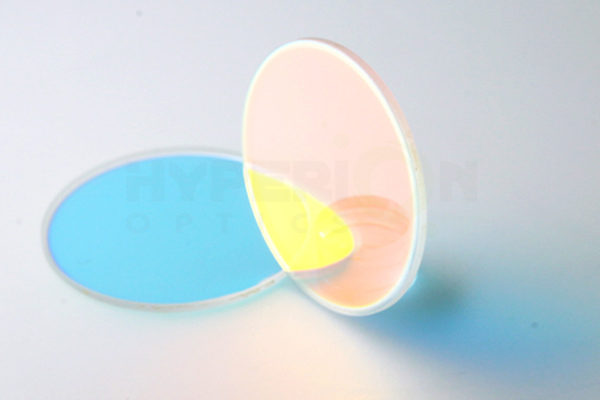
Heat mirrors and cold mirrors are special bandpass filters that can reflect infrared light and ultraviolet light and only allow visible light to pass through, also known as heat-absorbing filters, also known as IR cut filters. Heat Mirror will be a large number of heat generated near-infrared light isolated optical path to protect the heat-sensitive devices, where the need for high light intensity and need to be separated from the heat applications can be.

Dielectric HR Mirror
Reflective film from the coating material can generally be divided into two categories; one is the reflective metal film, one is all dielectric reflective film.

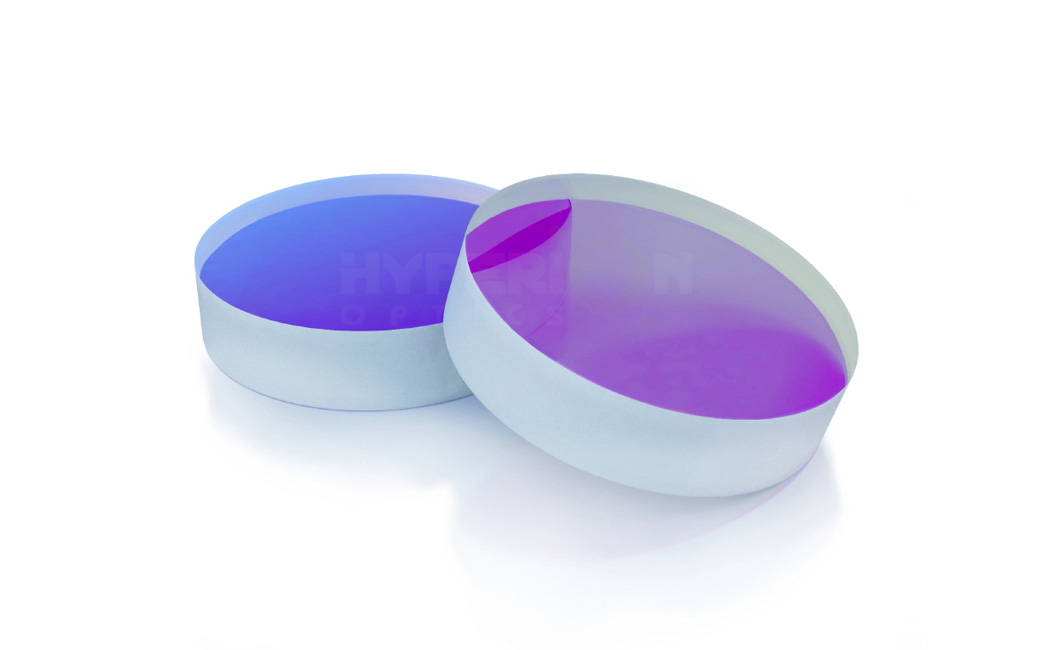
Media reflection film using the principle of multi-beam interference, which, contrary to the media anti-reflective film, can significantly improve the light in the air glass interface reflectivity. By alternately plating high and low refractive index multilayer films on the surface of the lens, the synthetic amplitude of the reflected light can be increased, and the reflectivity of the reflective film can be more than 99.9% of specially optimized design. In contrast, the reflectivity of the reflective metal film is only 97%.

Labels: , , , ,

What is optical filters

Fluorescence filter is a fluorescence imaging filter for biomedical and life science instruments, the key components, the main role is in the biomedical fluorescence analysis system for the separation and selection of substances in the excitation and emission fluorescence Of the spectral characteristics of the band. It is usually required that the filter cut-off depth be greater than OD5 (optical density, OD = -lgT). The core requirements for filters used in fluorescence detection systems are high cut-off steepness, high transmittance, high positioning accuracy, high cut-off depth, and excellent environmental stability.

Fluorescence filter is a combination of three, three are excitation filters, emission filters and dichroic filters.

Excitation Filter (Exciter Filter, Excitation Filter, Excitation Filter): In the fluorescence microscope, only the excitation wavelength of the filter can pass through the fluorescence. In the past, a short-pass filter was used, and now a band-pass filter is basically used. The housing is marked with arrows indicating the direction of propagation of the recommended light.

Emission Filter (Emitter Filter, Emitter): Select and transmit the fluorescence emitted by the sample, the other range of light cut-off. The wavelength of the emitted light is longer than the wavelength of the excitation light (closer to red). A band-pass filter or a long-wave-pass filter may be selected as the emission filter. The housing is marked with arrows indicating the direction of propagation of the recommended light.

Dichroic Mirror (Dichromic Beamsplitter, Dichromatic Beamsplitter): also known as dichroic mirrors or dichroic mirrors. And placed at an angle of 45 ° to the optical path of the microscope. This filter reflects one color of light (excitation light) and transmits another color of light (emitted light), the reflectivity of the excitation light is greater than 90% and the transmittance of the emitted light is greater than 90%. The impervious portion of the spectrum is reflected rather than absorbed. Filter in the transmitted light and reflected light color complement each other, and thus also known as dichroic filters.

Our optical filters are designed for fluorescence imaging applications, with durability in mind and high-performance optical specifications in manufacturing. The filter substrate is made of quartz, which can achieve 1/10 lambda surface accuracy, while the thermal expansion coefficient of quartz is relatively small, can obtain higher image quality.

We equipped with 4 coating chambers to provide various filters to our customers. For custom specifications, please talk to our coating engineers, we are more than happy to simulate the coating result for you. Contact us today, and find out our coating capability for your needs.

Bandpass Filter
Band pass filter can separate a band of monochromatic light, the ideal transmittance of band-pass filter through the bandwidth is 100%, while the actual band-pass filter pass band is not the ideal square. The actual band-pass filter generally has a center wavelength λ0, a transmittance T0, a half width of the pass band (FWHM, a distance between two positions where the transmittance in the pass band is half the peak transmittance), the cutoff range and other key parameters to describe.

Multichannel Filter
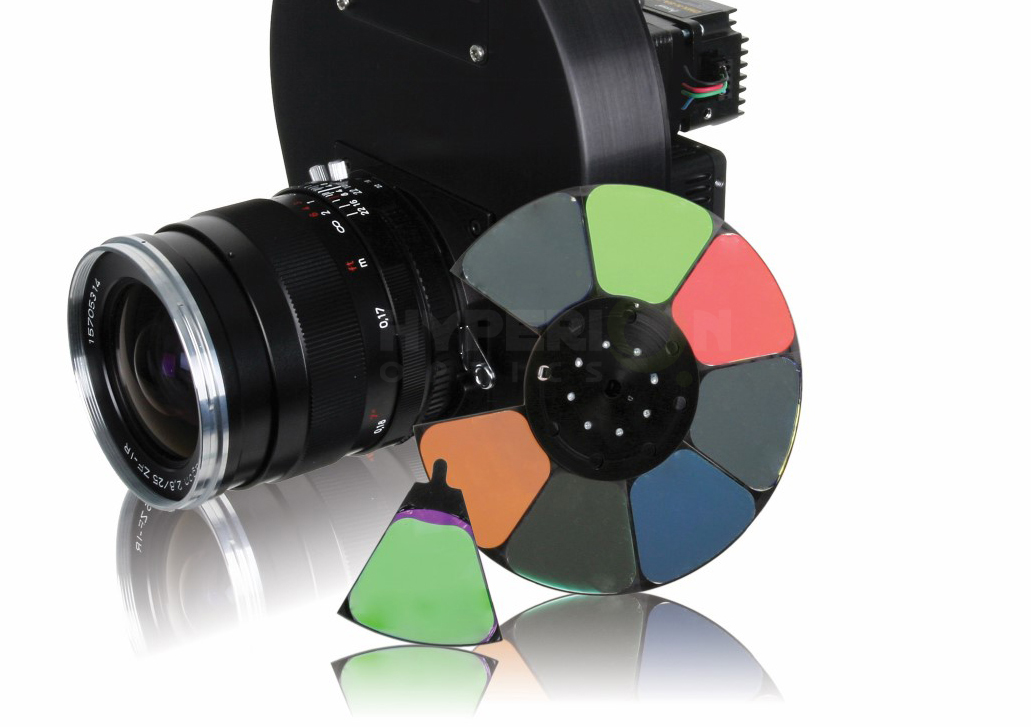
Multichannel filters differ from conventional bandpass filters by allowing only one continuous band of light to pass through it, allowing two or more bands of light to pass through.

Multi-channel filters can be achieved on a filter to achieve the need for multiple general filter stack to achieve the effect, making the design more compact, and can reduce costs.

This filter in the optical communications, infrared and medical applications have a wide range.

Neutral Density Filter

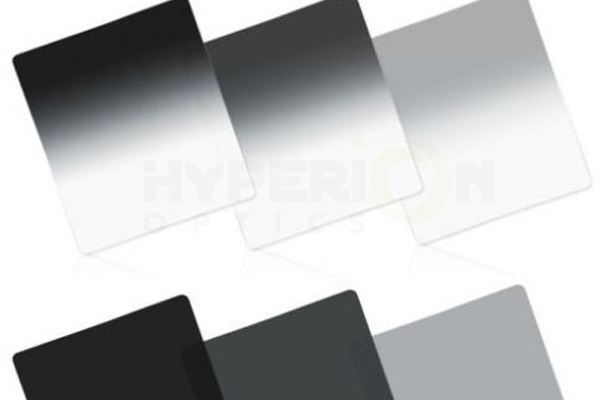
Neutral gray-scale filter is a non-selective filter, that is, ND mirror for a variety of different wavelengths of light to reduce the capacity is the same, uniform, only to weaken the role of light, and The original color of the object will not have any impact, so you can reproduce the real scene contrast.

The main purpose of using ND mirrors is to prevent over-exposure.

For example, when you want to extend the exposure time when the light is strong, use the ND lens to reduce the light entering the lens, you can use a slower shutter shot. For example, in the daytime when the light is strong with slow shutter speed to capture the waterfall to show the virtual effects of water and other special effects, you need ND mirror.

Labels: , , , , , , , ,

What is Prisms optical

Hyperion Optics supplies a range of prisms optical to meet UV-Visible-NIR applications, with high surface quality and tight tolerance angles.  Our materials selection ranges from flint/crown glasses, fused silica, ZnSe, CaF2 etc.

For custom need, such as cemented prism or additional treatment on the surfaces, please have us assess your requirement, our engineers are always happy to assist.

Right angle prisms turn light through 90° by internal reflection from the hypotenuse, or 180° from two right angle surfaces. When the light incident angle is perpendicular to the right angle surfaces, the light will be reflected at the surface of glass/air interface.

When the input light is incident from hypotenuse surface, the light will be fully reflected in the glass / air interface at the right angle surfaces. The second total reflection occurs at next right angle surface.

Compared to regular reflective mirrors, right angle prisms are easily to be mounted; further its reliable mechanical stress has better stability and strength. Hence right angle prisms have been considered as suitable alternatives to reflective mirrors in various applications.

Hyperion Optics supplies a range of right angle prisms to meet UV-Visible-NIR applications, with high surface quality and tight tolerance angles.  Our materials selection ranges from BK7, Bak4, fused silica, ZnSe, CaF2 etc.

Material tips for your application:

  • For working wavelength down to 175nm or so, with low thermal expansion requirement, Fused silica is the right choice with tighter tolerance control due to its excellent mechanical stability.
  • For visible and NIR wavelength, N-BK7 or CDGM H-K9L is suitable and cost effective.
  • For infrared wavelength, ZnSe and germanium are the right material to pick up.
  • Calcium fluoride has relatively wide transmittance range from 0.18~8um, it is the best choice when your application covers such wide transmission range.

Hyperion Optics has full capability of processing right angle prisms based on the materials we proposed above with 3 precision levels fit your actual demand.

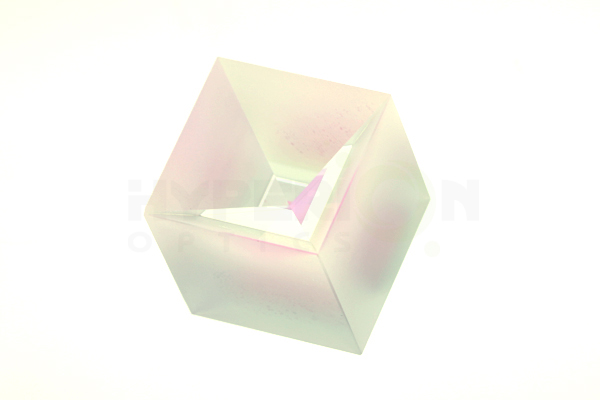
Cemented Prism Cube

Cemented Prism Cube

Hyperion Optics are specialist of providing custom prisms, meanwhile, we are also capable of precision prism bonding of custom design.

From simple bi-prism bonding to multiple elements cementing, we provide detailed testing report regarding key specs such as angles, surface accuracy and coating measurement. Let us help you with your own custom bonding design.

Corner Cube Retroreflectors

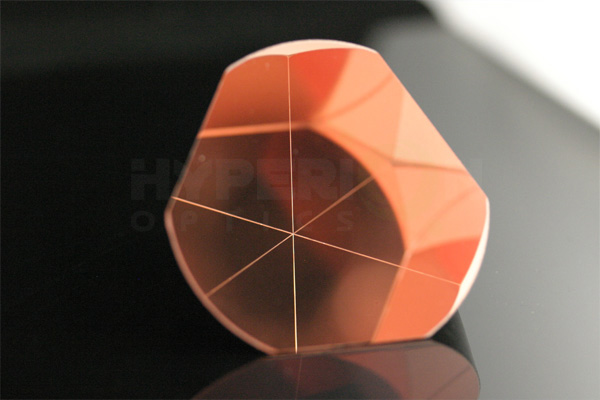
Corner cube is total reflecting prism formed by 3 perpendicular surfaces, where the incident light angle does not influence the final emerging light angle but reflected by 180°, it offers excellent parallelism between the incident and exit beams.

Hyperion Optics supplies both corner cube in mount or without mount, our precision corner cube retroreflectors have been used for Laser ranging, positioning and guidance, laser communication, optical transformation.

Dove Prism
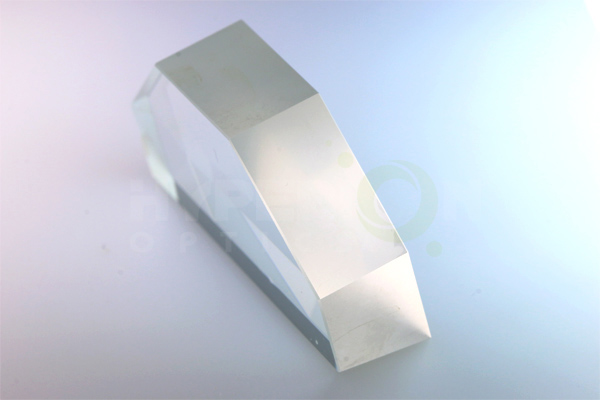
Dove prisms are used as reflective prism inverting the image. Dove prism is shaped from a truncated right-angle prism. Normally, dove prisms are used in the parallel optical path based on critical angle principle to meet total internal reflection with limited FOV.

A beam of light entering one of the sloped faces of the prism undergoes total internal reflection from the inside of the longest (bottom) face and emerges from the opposite sloped face. Images passing through the prism are flipped, and because only one reflection takes place, the image is inverted but not laterally transposed.

Labels: , , , , , ,

What is Laser crystal optical components

Hyperion Optics provides optical components, including laser crystals for a wide range of laser, semiconductor, military, space and fiber optics applications. We work on high power visible and UV light generation by delivering high quality nonlinear products reaching our customer specifications.

Our crystals solution includes BBO, BIBO, KTP, anti gray tracking KTP, LiNbO3, Nd YAG crystal and wafer and much more. With 1/10 lambda precision, coated/un-coated options, competitive pricing.

buy laser crystal, contact rfq@hypoptics.com


KTP crystal is mostly used as nonlinear crystals for frequency doubling of solid-state Nd:YAG crystal or Nd:YVO4 crystal laser, as it has large nonlinear optical coefficients, wide angular bandwidth and small walk-off angle, broad temperature and spectral bandwidth. KTP crystal also has high electro-optic(E-O) coefficient and low dielectric constant, and large figure of merit, these features make it also widely used in electro-optic application.

Advantages of KTP Crystal:

  • Large Nonlinear Optical (NLO) Coefficients
  • Wide Angular Bandwidth and Small Walk-off Angle
  • Broad Temperature and Spectral Bandwidth
  • High Electro-Optic (E-O) Coefficient and Low Dielectric Constant
  • Large Figure of Merit for an Optical Waveguide Modulator
  • Nonhygroscopic, Good Chemical and Mechanical Properties

There are mainly three types of crystals:

KTP Crystal

KTP crystal is mostly used as nonlinear crystals for frequency doubling of solid-state Nd: YAG crystal or Nd:YVO4 crystal laser, as it has large nonlinear optical coefficients, wide angular bandwidth and small walk-off angle, broad temperature and spectral bandwidth. KTP crystal also has high electro-optic(E-O) coefficient and low dielectric constant, and large figure of merit, these features make it also widely used in electro-optic application.

Advantages of KTP Crystal:

  • Large Nonlinear Optical (NLO) Coefficients
  • Wide Angular Bandwidth and Small Walk-off Angle
  • Broad Temperature and Spectral Bandwidth
  • High Electro-Optic (E-O) Coefficient and Low Dielectric Constant
  • Large Figure of Merit for an Optical Waveguide Modulator
  • Nonhygroscopic, Good Chemical and Mechanical Properties

BBO Crystal


The BBO Crystal is a high-temperature phase of BaB2O4, is an excellent birefringent crystal an efficient NLO crystal for the second, third and fourth harmonic generation of Nd: YAG lasers, and the best NLO crystal for the fifth harmonic generation at 213 nm. Conversion efficiencies of more than 70% for SHG, 60% for THG and 50% for 4HG, and 200 mW output at 213 nm (5HG) have been obtained, respectively. BBO Crystal has been widely used in 2,3,4 or 5 harmonic generations for high power visible/UV sources, and optical parametric conversions for high power broadly tunable sources.

Advantages of BBO Crystals

  • Broad phase-matching range from 409.6 nm to 3500 nm
  • Extensive optical transmission from 190 nm to 3500 nm
  • Large effective second-harmonic-generation (SHG) coefficient
  • High damage threshold of 10 GW/cm2 for 100 ps pulse-width at 1064 nm
  • Wide temperature-bandwidth of about 55℃
  • Excellent mechanical and physical properties

YAG Crystal

Undoped YAG Crystal is an excellent material for UV-IR optical windows, particularly for high temperature and high energy density applications. The mechanical and chemical stability is comparable to sapphire crystal, but YAG is unique with non-birefringence and available with higher optical homogeneity and surface quality. Up to 3 YAG boule grown by CZ method, as-cut blocks, windows and mirrors are available from CryLight.
Specifications

Specifications:
Orientation: < 111 > +/-5deg
Diameter Tolerance : +0.0 /-0.1mm
Thickness Tolerance: +/-0.2mm
Surface Quality: better than 10/5 scratch/dig
Parallelism: < 30 arcsec
Flatness: < λ/8 @632.8nm
Perpendicularity: < 5 arcmin
Wavefront Distortion: < λ/2 @632.8nm
Coating: Coating upon Request

Labels: , , , , , , , , ,

Laser Optics

Protect scan lenses from backsplatter and other workplace hazards, Hyperion Optics offers protective windows -- also known as debris windows -- that are either included as the overall scan lens assembly part, or sold separately. These plano-plano windows are available in both ZnSe and Ge materials and also supplied mounted or unmounted.

ZnSe windows feature our standard AR or DAR coating. Ge protective windows feature either our standard AR coating, or an optional diamond-like carbon coating (DLC) designed to withstand the most severe conditions likely to be encountered in industrial operations.

For lasers with infrared wavelengths, such as, for example, 10.6 µm in CO2 lasers, lenses and windows made of zinc selenide (ZnSe) are used. Silicon or copper mirrors are used as mirrors. Phase shift mirrors used to produce circular polarization are also available. Beam expanders and diffractive elements for beam shapes complete our product range.

Zinc selenide components are primarily used for transmissive optics. They are made exclusively with high quality "laser grade" material that can be used even in the kW range. When coated, these zinc selenide elements have a transmittance of T > 99.5 % at 10.6 µm.
buy protective windows, contact rfq@hypoptics.com


Protective Windows

Protective Window is applied to isolate different physical environments while allowing light to pass through. When selecting windows, please consider the material, transmission, scattering, wave front distortion, parallelism and resistance to certain environment. We offer all kinds of windows, which are made from different materials.
Single layer, multiplayer anti-reflecting coatings on optical windows are also available upon request.

Specifications
Diameter Tolerance: +0.0, -0.2 mm
Thickness Tolerance: ±0.2mm
Clear Aperture: >80%
Parallelism: <3 arc min
Surface Quality: 40-20 scratch & dig
Flatness λ /2 @632.8nm per 25mmDia

ZnSe Focusing Lenses

Hyperion Optics supplies off-the-shelf ZnSe focusing lenses. Please select from below specifications.

Specifications
Diameter Tolerance +0/-0.13mm
Thickness Tolerance ±0.25mm
FL Tolerance <±2%
Centration <3 arc minutes
Clear Aperture >90%
Surface Figure <λ/2 per 1”Dia@632.8nm
Surface Quality 40-20 scratch and dig
AR/AR coating R<0.15% per surface @ 10.6um

Labels: , , , , , ,